The Microwave Road for Marines: Why the Pentagon is Seeking a Cheap Answer to Drones

On the modern battlefield, the main problem of air defense is increasingly not technology, but arithmetic.
“We can no longer afford to spend million-dollar missiles on targets that cost pennies. It’s time to change the very economy of interception.”
Shooting down a cheap drone with a missile that costs hundreds of thousands or even millions of dollars is tactically effective but strategically disastrous. This is why the U.S. Marine Corps is increasingly investing in systems designed to radically reduce the cost of a single interception.
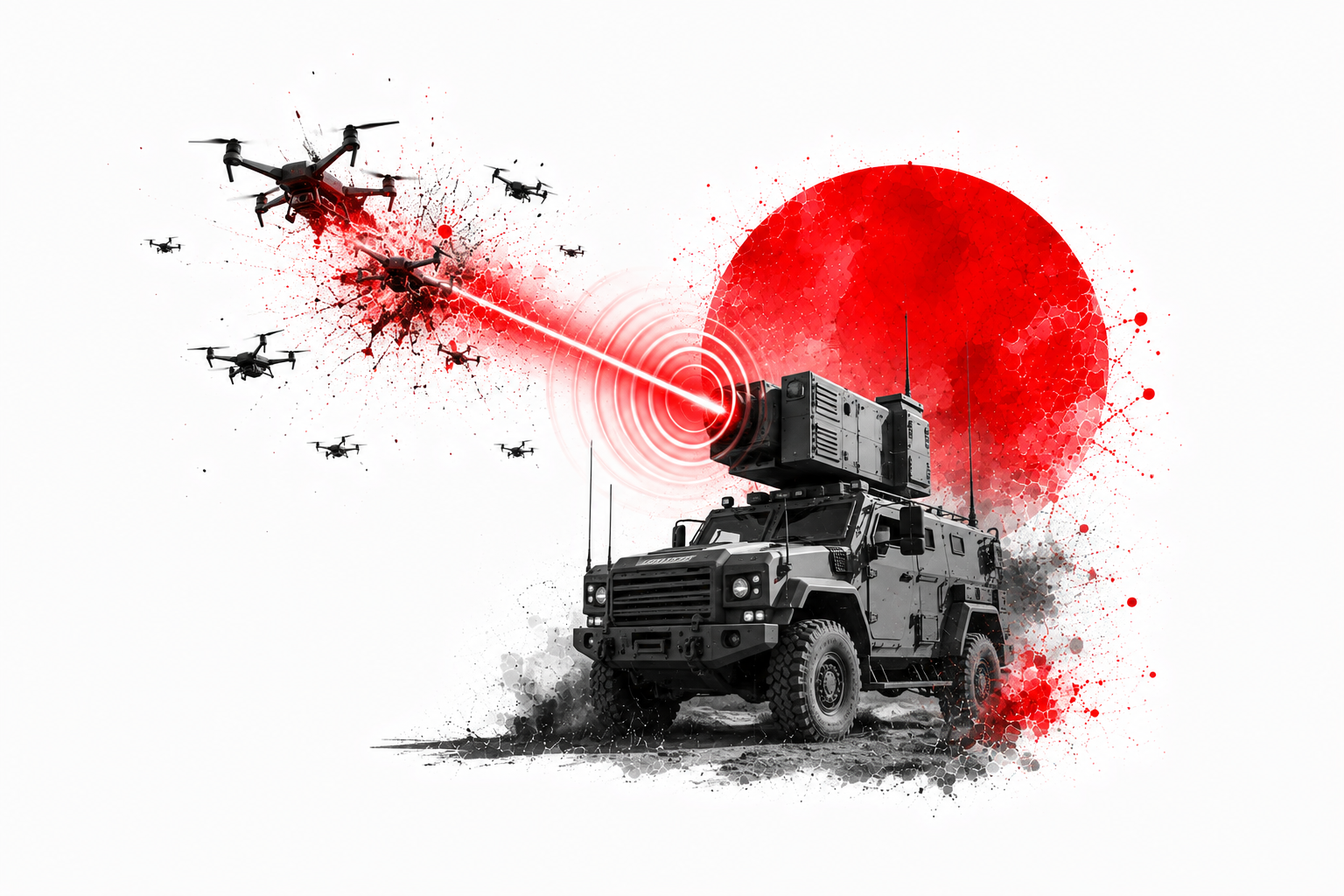
One of the most notable examples is HAVOC (High-power Microwave Autonomous Vehicle Operational Capability) from the company Epirus. The system uses directed high-power microwave radiation to damage the electronics of drones.
While traditional air defense destroys a target with a missile or shell, HAVOC works differently: the pulse is designed to incapacitate the electronic components of several drones in the impact area.
War of Budgets
Here is where the new logic of War 4.0 manifests.
The problem with classic air defense is not that it has stopped working. On the contrary, modern interception systems are often tremendously effective.
But they were developed to combat expensive aircraft, cruise missiles, and other complex targets-not with mass-produced drones that can be manufactured by the thousands.
This results in a dangerous asymmetry.
If the opponent spends a few thousand dollars on a drone, and the defender spends hundreds of thousands to destroy it, even a successful defense gradually turns into an economic defeat.
In a war of attrition, it is not the one who shoots down more targets that wins, but the one who spends less on scarce resources.
One Pulse Instead of a Dozen Missiles
This is why microwave weaponry appears attractive.
It does not require separate missiles for each target. There is no need for complicated engines, explosives, or guidance systems in every shot.
The main resource is electricity.
Theoretically, one system can attack targets multiple times as long as it has sufficient power and cooling. This fundamentally changes the economics of defense against mass swarms.
It is especially important that high-power microwave radiation potentially allows engagement not with one drone but with a group.
For the modern battlefield, this is a critical advantage. Swarms of drones are specifically designed to overwhelm a classic air defense system with a large number of cheap targets.
Not a Panacea
However, “the big microwave” does not cancel traditional air defense.
Such systems have limited range, depend on power supply, and the effectiveness of electronic engagement against specific targets. Protected electronics, shielding, and design changes in drones will inevitably lead to new countermeasures.
Therefore, future counter-drone defenses will likely be multi-layered.
Long-range and expensive targets will be destroyed by missiles. Cheap drones-by guns, lasers, electronic warfare means, and microwave weapons. The cheapest available means will be applied against the cheapest corresponding threat.
This is how military economics is gradually changing.
The End of the Era of Expensive Shots
HAVOC is important not so much as a separate system but as a symptom of a larger transition.
Armies are beginning to realize that technological dominance can no longer be measured only by the cost of a missile or the complexity of a platform.
In mass warfare, the cost of effect becomes more important.
If one electromagnetic pulse can replace several expensive interceptors, it may be strategically more valuable than a significantly more complex system.
The U.S. Marine Corps is interested in “microwave guns” not because of their exotic nature. It is merely adapting to the new arithmetic of warfare.
In War 4.0, there is a simple rule: if destroying a cheap threat costs more than producing it, sooner or later, the defender will lose.

Read also