Physicists Develop a Time Crystal from 3D-Printed Metamaterial Exhibiting a Robust Rhythmic Pattern

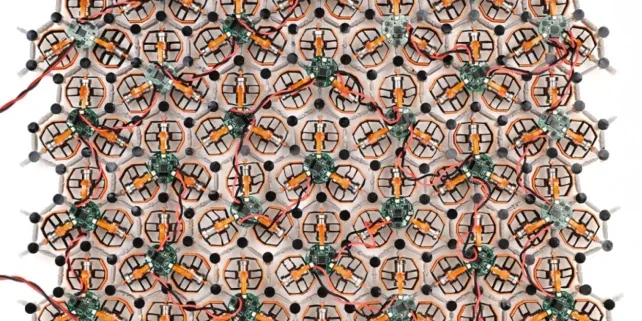
From Disorder to Harmony: Creating a Time Crystal That Maintains a Consistent Beat
According to НВ — Техно: A multinational team of physicists led by Jonas Weenstroem from the University of Amsterdam in the Netherlands has achieved a breakthrough by engineering a time crystal using a 3D-printed metamaterial. This innovative structure independently generates a steady, synchronized rhythm, illustrating a remarkable transformation from chaotic motion to an ordered oscillation resilient to external noise. The findings were published in the journal Nature in 2026.
Experimental Setup and Key Findings
The metamaterial used in the study features a honeycomb lattice composed of 37 modular units. Each unit contains three hexagonal components equipped with sensors, actuators, and microcontrollers. A distinctive non-reciprocal interaction among these hexagons causes the compression of one hexagon to trigger a clockwise compression in its neighbor and a counterclockwise expansion in another. This mechanism results in the entire assembly moving in unison at a fundamental vibration frequency around 30 Hz.
A crucial part of the research involved testing a ring-shaped metamaterial with 24 motors placed on an air-cushioned table. This setup confirmed the presence of feedback mechanisms that enhance the stability of the synchronized rhythm. Remarkably, the constructed time crystal maintained its coordinated oscillation even under significant noise disturbances.
The implications of this research extend beyond fundamental physics, offering promising prospects for advanced metamaterial design and applications in fields such as:
- Acoustics
- Soft robotics
- Optomechanics
This discovery paves the way for future innovations in creating complex adaptive systems capable of sustaining ordered dynamics amid fluctuating environments-an increasingly valuable trait in today’s rapidly evolving technological landscape.

Read also