Constitutional Court Upholds Early Parole Eligibility for Serious Corruption Offenses

Review of the Constitutional Complaint
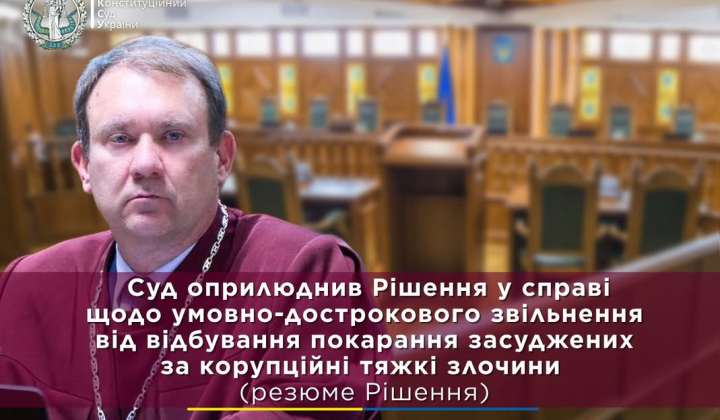
According to Конституційний суд: On November 18, 2026, Ukraine’s Constitutional Court examined a constitutional complaint filed by Volodymyr Mykhailovych Treizub challenging the constitutionality of paragraph 2, part 3, article 81 of the Ukrainian Criminal Code. This provision governs the conditions under which individuals convicted of serious corruption crimes may qualify for early parole. The Court issued Decision No. 15-р(ІІ)/2026, confirming the provision’s constitutionality under specific circumstances.
The case was heard by the Court’s Second Senate, with Judge Oleg Pervomaiskyi serving as the reporting judge. It was clarified during proceedings that paragraph 2, part 3, article 81 allows for conditional early release after serving at least two-thirds of a sentence for corruption-related offenses classified as non-serious, as well as other crimes. Importantly, this early release option can also apply to those convicted of intentional serious offenses, including serious corruption crimes. The matter is additionally regulated by article 154 of the Criminal Executive Code of Ukraine.
Findings of the Constitutional Court
The Court concluded that paragraph 2, part 3, article 81 of the Criminal Code aligns with the Ukrainian Constitution. This ruling came after the Chernihiv Court of Appeals previously interpreted the same provision as unconstitutional in a case concerning early parole, prompting the need for constitutional review. The Court emphasized that
“the wording of paragraph 2, part 3, article 81 permits a constitutionally consistent interpretation, enabling courts to grant early parole to persons convicted of intentional serious crimes regardless of the specific nature of the offense, including serious corruption crimes.”
Furthermore, the Court highlighted that
“the state must guarantee the protection of human dignity for all convicted individuals, recognizing that correction and social rehabilitation are fundamental rights of every prisoner.”
In line with constitutional values, every convicted person holds the right to dignity and access to early parole mechanisms. The Court also noted that interpreting paragraph 2, part 3, article 81 in a way that excludes eligibility for early release for those convicted of serious corruption offenses contradicts core constitutional principles such as good governance, rule of law, human rights protection-especially dignity-equality, and Ukraine’s European integration commitments.
The Constitutional Court’s decision has been officially published on its website, allowing public access to the full text and key details concerning early parole eligibility for convicted individuals.
This ruling is expected to significantly influence judicial practice in Ukraine, particularly in corruption-related cases. It underscores the state’s commitment to uphold human rights even for those convicted of grave offenses, striving to balance individual rights with societal demands for effective anti-corruption measures. The interpretation of these Criminal Code provisions will likely continue to generate discussion within Ukraine’s legal community and society at large.
In light of the recent ruling by the Constitutional Court, it is important to consider the implications of this decision on the legal landscape regarding early release for serious crimes. For a deeper understanding of how the Court's interpretation affects the treatment of serious corruption offenses, read more about the upholding of early release regulations and the criticisms of previous court interpretations.

Read also