James Webb Space Telescope Detects Infrared Emission from H3+ Ion in HH 168 for the First Time

James Webb Telescope Uncovers Infrared Signals from H3+ Ion
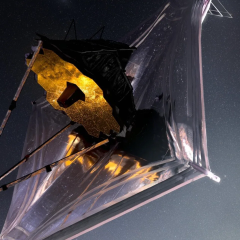
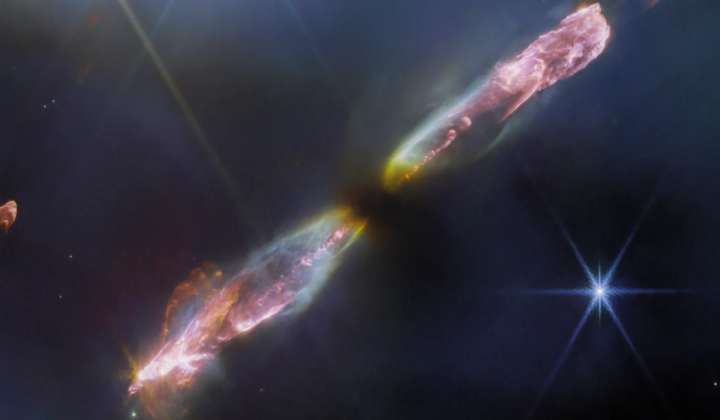
According to НВ — Техно: The James Webb Space Telescope has achieved a groundbreaking first by detecting the infrared emission of the H3+ ion, a phenomenon predicted by astrophysicists in 1986. This signal was observed within the gas flows surrounding young stars, specifically at the Herbig-Haro object HH 168. This discovery was led by an international research team headed by David Neufeld from Johns Hopkins University. Their findings have been accepted for publication in The Astrophysical Journal Letters.
Understanding the H3+ Ion
The H3+ ion is a molecular cation composed of three hydrogen nuclei and two electrons. In the spectrum of HH 168, astronomers identified 26 emission lines corresponding to forbidden rotational transitions of this ion. The strongest detected signal exhibited an extraordinary statistical significance of 72 sigma, underscoring its reliability. Due to its symmetrical triangular shape, H3+ lacks a permanent dipole moment; however, rotational motion distorts its structure, generating a weak dipole moment that enables it to emit light.
This phenomenon was first theorized in 1986 by Fu-Shi Pan and Takeshi Oka.
The detected H3+ emission originates from hot gas heated by shock waves created when jets of material ejected from young stars collide with surrounding molecular clouds. These jets can reach speeds of several hundred kilometers per second, heating the gas to thousands of degrees. While existing models strive to explain the brightness of H3+ emission, some underestimate its intensity by a factor of five to six. Similar emissions have also been identified in archival data of another Herbig-Haro object, HH 211.
David Neufeld's team’s research opens new avenues in astronomy by enhancing our understanding of the dynamic environments around young stars. The preprint of this study is available on arXiv, providing a valuable resource for further investigation into this significant discovery.
Detecting the H3+ ion with the James Webb Space Telescope marks a major advancement in studying the physical processes in the gas flows surrounding newborn stars. This observation validates theoretical models developed over decades and paves the way for deeper exploration in molecular astrophysics. Investigating ions like H3+ holds the potential to greatly expand our knowledge of star formation and the characteristics of their cosmic neighborhoods.
This remarkable detection of the H3+ ion's infrared emission not only highlights the capabilities of the James Webb Space Telescope but also draws parallels to another intriguing discovery. Recently, the telescope identified a mysterious bright signal in Hubble’s Ultra Deep Field, raising questions about the origins and implications of such emissions in the cosmos. To explore this fascinating connection further, read more about the mysterious bright signal detected by the James Webb Telescope.

Read also