Poland’s Suloshova Village Preserves Its Unique 700-Year-Old Medieval Linear Layout

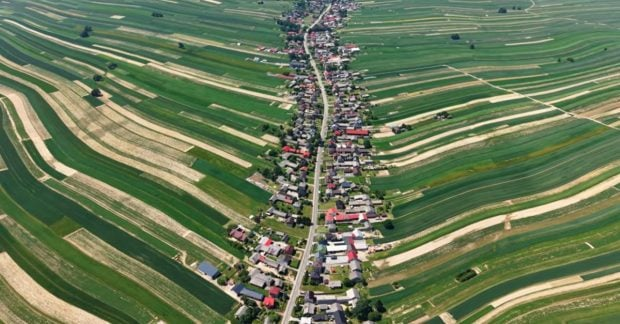
Suloshova: A Rare Village with a Medieval Linear Design
According to УНІАН — Туризм: Located just 30 kilometers from Krakow, the Polish village of Suloshova has maintained a distinctive settlement pattern for over seven centuries. Residents have long lived stretched along a single nine-kilometer road, an uncommon urban form known as Ulicówka. With a population of 3,347 in the village itself and 5,575 in the surrounding rural community, Suloshova lies in the picturesque valley of the Prądnik River within Ojców National Park, a protected natural area cherished for its scenic beauty.
The village’s architectural layout stands out for its linear arrangement. Homes, shops, and public buildings line Voivodeship Road 773, which extends nearly 9 kilometers. Unlike typical towns that develop around a central marketplace with branching streets and neighborhoods, Suloshova centers almost entirely on this one main thoroughfare. Remarkably, despite centuries of upheaval, wars, and modernization, this original spatial organization has remained intact, highlighting the village’s resilience and historical significance.
Historical Roots and Cultural Significance
Although officially founded in the 16th century, Suloshova’s spatial design dates back to medieval times. Local legend holds that the land was granted to a knight named Sulosh by one of Krakow’s princes. The village’s agricultural plots are characterized by long, narrow strips that create a patchwork landscape. Seasonal changes enhance this striped mosaic, giving Suloshova a striking countryside appearance often compared to Tuscany for its charming vistas.
Situated near Ojców National Park, the area is known for its dense forests, dramatic gorges, and roughly 400 caves. Nearby stands the 14th-century Pieskowa Skała Castle, originally built under King Casimir III the Great and later transformed into a Renaissance residence. Another notable natural feature is Hercules’ Club, a towering rock formation about 30 meters tall.
Residents actively celebrate their heritage through festivals dedicated to strawberries and potatoes, traditions that both preserve local culture and draw visitors. The village’s historical layout has gained attention through drone photography and videos, showcasing the unique form of the settlement. Katarzyna Będa from the local council describes the village’s shape as resembling a giant leaf, with the main road acting as the central vein and fields branching off like smaller veins on either side. Suloshova thus remains a living monument to Poland’s rural history and a fascinating destination for travelers.
Thanks to its exceptional architectural and natural heritage, Suloshova offers valuable insights into traditional Polish village life. Efforts to protect its cultural legacy and enhance tourism infrastructure not only support economic growth but also strengthen the preservation of regional identity. The village continues to play a vital role in maintaining the cultural memory of the area, bridging the past with the present for future generations.

Read also