3000-Year-Old Bronze Sword Casting Mold Unearthed in Bavaria Reveals Ancient Metalworking Expertise

Remarkable Archaeological Discovery in Bavaria
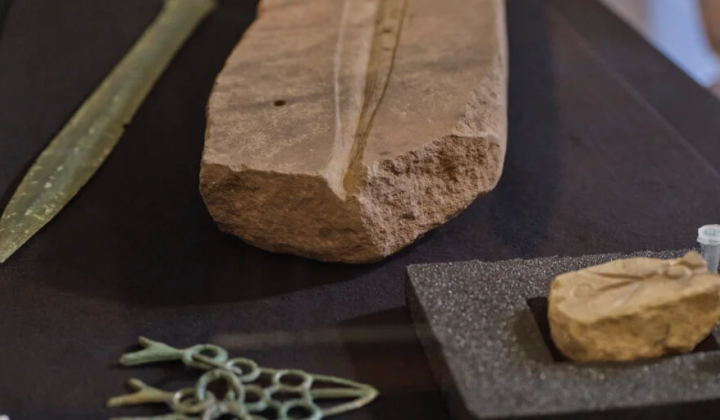
According to НВ — Техно: In Bavaria, archaeologists have uncovered a rare sandstone casting mold dating back approximately 3000 years, used to produce bronze swords. This finding provides compelling evidence of advanced metalworking techniques in the region during the Bronze Age. Alongside the sword mold, experts also discovered forms for crafting ornamental jewelry and a substantial hoard of bronze artifacts, highlighting the area's historical significance in ancient metallurgy.
The sword casting mold was excavated near the settlement of Großaitstadt in Lower Franconia. This artifact consists of one fully intact half of the mold, designed for casting swords with narrow tangs. Another mold found at the same site was used to create decorative beads. The settlement itself belongs to the Urnfield culture period, which spans from 1300 to 800 BCE.
Unveiling the Finds and Ongoing Research
These important discoveries were officially presented on November 11, 2026, in Munich during a joint event held by the Bavarian State Office for the Preservation of Monuments (BLfD) and the Archaeological Society of Munich (ASM). Earlier, in October 2024, metal detectorists near Grabenstätt in the Chiemgau region of southern Bavaria uncovered numerous bronze items dating to the late Urnfield period, around 880–800 BCE. The collection includes:
- 52 bronze rings for wrists and ankles
- two bronze axes
- fragments of a bronze bracelet
- remnants of a bronze vessel
- a large bronze casting ingot roughly the size of a plate
BLfD coordinated detailed analysis of these artifacts throughout 2025 and 2026. Additionally, in 2023, excavations in Nördlingen, southern Bavaria, revealed a 3000-year-old bronze sword buried in a grave. The sword shows no signs of wear, indicating it was fully functional as a weapon. Its narrow tang allowed for secure attachment of the hilt. As researcher Jess Thomson explained:
“Its balance made it effective for combat, capable of striking down opponents.”
These discoveries emphasize Bavaria’s role as a vital hub of metalworking during the Bronze Age and open new perspectives on the social and cultural evolution of the region in prehistoric times. The artifacts not only demonstrate the high craftsmanship achieved in Bavaria but also suggest the area's importance in trade and cultural exchanges throughout the Bronze Age. Ongoing archaeological work continues to deepen our understanding of ancient European civilizations and their technological advancements, which may significantly influence future historical research.
This recent discovery in Bavaria is part of a larger trend of significant archaeological finds in Central Europe. For instance, a 4300-year-old burial site of a woman and her newborn was uncovered in the Czech Republic, shedding light on the burial practices and social structures of the Bronze Age. Such findings collectively enhance our understanding of ancient cultures in the region.

Read also