War 4.0. Strategy. Tactics. Scaling

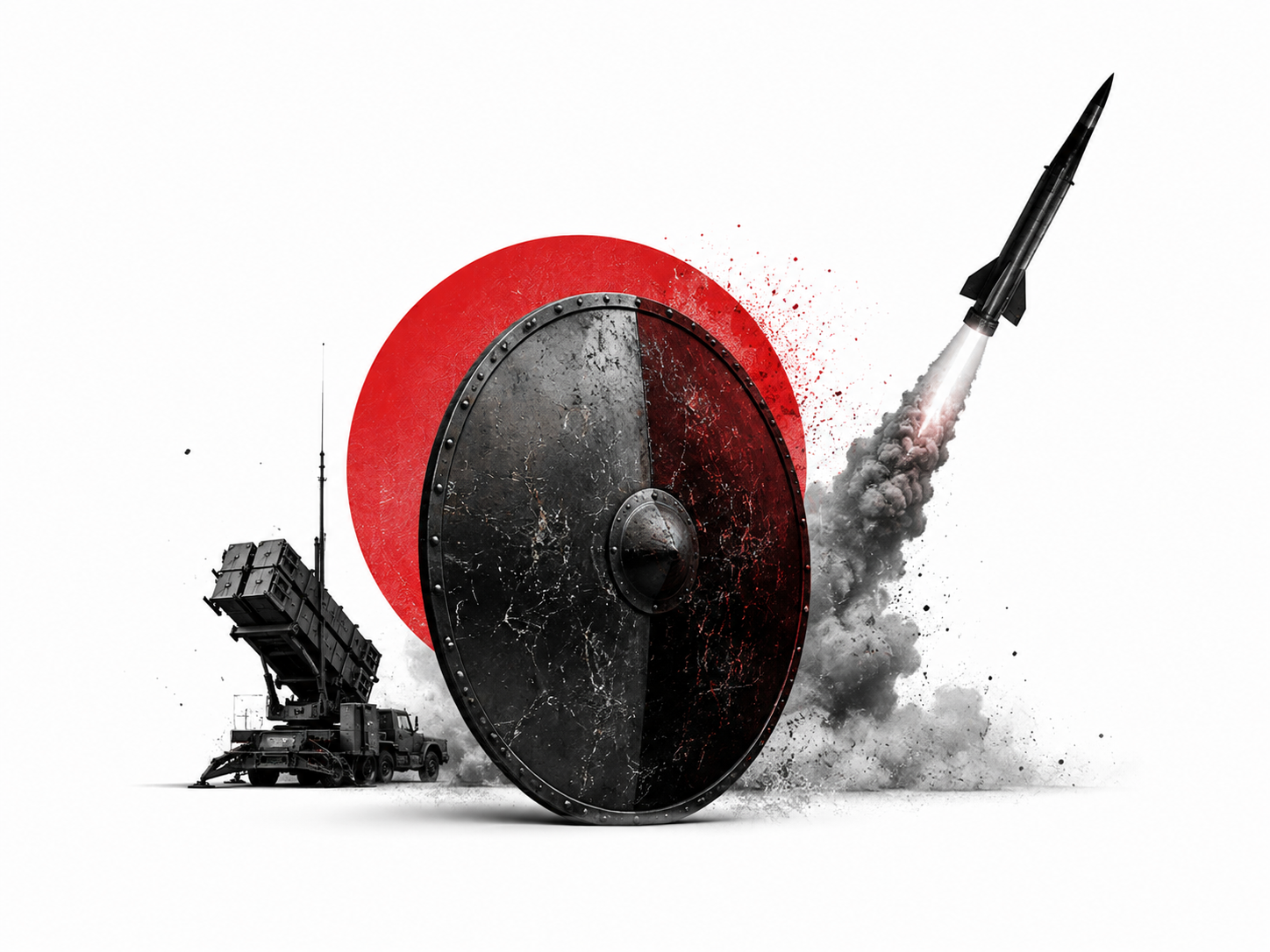
Shield and Sword
The global confrontation of the 21st century increasingly resembles not a chess game of generals, but the accounting of industrial capabilities. It is not only the one with better weapons who wins, but also the one who can produce them faster, cheaper, and for longer.
The experience accumulated by August 2026 demonstrates a fundamental change in the nature of warfare. The new type of war is transforming into an endless technological duel between offensive and defensive measures.
Between the Sword and the Shield.
For the first time in many decades, the Shield is beginning to dangerously lag behind.
Shield Deficit
The specialized ballistic missile defense of the West remains technologically complicated, expensive, and, most importantly, slow to produce.
The American Patriot remains the backbone of this framework. According to open estimates, the U.S. has the largest reserve of PAC-3 MSE missiles - approximately 2,500-3,000 units. However, a significant portion of this is a strategic reserve of the Pentagon itself, particularly in case of a potential large war in the Indo-Pacific region.
The European stock is significantly more modest. Germany, the Netherlands, Poland, Romania, and other Patriot operators together may have around 800-1,000 missiles of various modifications. The actual amount of munitions that can be deployed without critically weakening one's own defense is much smaller.
The industry is trying to catch up with the new reality. Lockheed Martin's production capacities are gradually approaching approximately 600-650 PAC-3 MSE per year.
This is a lot by peacetime standards.
For a large war - little.
European Alternative
France and Italy have their own variant - SAMP/T and the Aster missile family.
The new Aster 30 Block 1NT is supposed to enhance European capabilities for intercepting ballistic targets, but the system is only entering the phase of large-scale deployment.
Production remains the main limitation.
The MBDA consortium produces approximately 120-150 Aster missiles of various modifications per year. The production of specialized ballistic missile versions is measured no longer in hundreds, but in dozens.
Europe has created a high-tech Shield.
It just has not learned how to manufacture it on an industrial scale.
Israeli Exception
The third major center of missile defense is Israel.
Arrow 2, Arrow 3, and David’s Sling create one of the densest multi-layered missile defense systems in the world. The stocks of anti-missile weapons can be estimated in hundreds of units, and production has accelerated after recent conflicts.
However, this arsenal has one peculiarity: it is almost entirely tied to the Middle East.
For Europe, this is more a demonstration of what is technologically possible than a reserve one can realistically count on.
Sword Conveyor
On the other side of the equation operates a significantly simpler logic.
Russia has restructured a significant part of its military-industrial complex for the mass production of missile weapons. According to open estimates, the production rates of ballistic missiles of the Iskander-M family can reach approximately 60-65 units per month.
In addition, there are Kinzhal missiles, other types of missiles, and munitions that can be used against ground targets.
But Moscow has gained another advantage.
North Korea.
Pyongyang has established mass production of the KN-23 and KN-24 and can supply Russia with additional dozens of ballistic missiles each month.
This has led to a sort of military-industrial cooperation between the two states, for whom the speed of production is more important than the technological perfection of each individual missile.
In the broadest calculation, the combined potential of Russia and North Korea could exceed 900-1,000 ballistic missiles per year.
The West is capable of producing anti-missiles at a significantly higher technological level.
The problem is that there may not be enough of them.
The Economics of a Single Interception
It is here that the main paradox of War 4.0 emerges.
To destroy a relatively inexpensive means of attack, one often has to use a significantly more expensive means of defense.
A missile flies once.
The anti-missile system must be ready every time.
If two air defense missiles are fired for guaranteed interception of one complex target, the arithmetic becomes even worse.
Therefore, modern missile warfare is gradually turning into a competition not of characteristics, but of factories.
How many missiles can be produced per month?
How long does the production cycle take?
What is the cost of one launch?
And how many years can the economy sustain this pace?
In this arithmetic, the Sword gains a structural advantage.
So why doesn’t the Sword win?
It would seem that the answer is obvious. If there are more means of attack than means of interception, the defense must eventually break.
But this does not happen.
The reason is a fundamental feature of modern warfare: missile superiority does not equate to territorial superiority.
Ballistic missiles can destroy power plants, factories, logistics hubs, and urban infrastructure. They can exhaust air defense systems, raise the economic cost of war, and create constant psychological pressure.
But a missile does not occupy territory.
For this, infantry is still needed.
And herein begins a completely different war.
Transparent Front
The battlefield of the 21st century has become almost transparent.
Reconnaissance drones observe tens of kilometers of the front. FPV drones attack individual vehicles and infantry groups. Minefields block maneuver. Artillery receives target coordinates almost in real-time.
What was once called concentration of forces for a breakthrough easily turns into the concentration of targets today.
A column of armored vehicles no longer disappears beyond the horizon.
It is seen.
Therefore, even a huge stockpile of missiles does not solve the main problem of offensive warfare: how to move thousands of people and hundreds of vehicles across territory where almost every movement can be detected and attacked.
The Sword has become stronger.
But the battlefield has simultaneously become a much better Shield.
Strategy of Dosed Defense
There is another level to this war - political.
The chronic deficit of anti-missiles for Ukraine can be explained by the industrial weakness of the West. But only by that - hardly.
Washington and European capitals are forced to solve several tasks simultaneously: support Ukraine, maintain their own strategic reserves, prepare for potential crises in the Middle East and Asia, and prevent uncontrolled escalation with Russia.
The result is a policy of dosing.
Ukraine receives enough means so that its air defense does not disappear. But not enough to create guaranteed protected skies over the country.
This difference is important to understand.
The assertion that the West deliberately leaves Ukrainian cities vulnerable to coerce Kyiv into a future agreement remains a political hypothesis, not an established fact.
But the consequence of the Western policy is quite real: Ukraine is waging a war under conditions of a constant deficit of the most expensive means of defense.
And this deficit in itself becomes an instrument of influence.
The Cost of Time
Therefore, the strategic question is not framed as follows: who has the better missile?
And not even as: who has more missiles?
The main question of War 4.0 is - who can scale faster than the opponent.
If Russia and North Korea can ramp up production of means of attack faster than the U.S. and Europe can produce means of interception, time works for the Sword.
If the West can turn the production of Patriot, Aster, and other systems from an almost artificial high-tech process into a real industrial conveyor, the ratio will change.
That is why the wars of the 21st century are again returning to the place where the wars of the 20th century began.
At the factory.
Strategy determines what needs to be produced. Tactics determine how to apply it.
But in a long war, a third word becomes decisive.
Scaling.

Read also