How AI Agents Are Taking Over 60% of HR Work and Redefining the Profession

The AI Revolution in Human Resources: Automating the Majority of Work
According to AIHR: Artificial intelligence agents are transforming Human Resources by automating and scaling core processes, freeing professionals to focus on strategic initiatives. This shift is significant for businesses looking to improve efficiency and employee experience. According to data, these autonomous systems can perform or support over 60% of functional HR tasks and 88% of administrative workflows. Furthermore, AI agents can handle up to 50% of routine HR inquiries through self-service platforms.
Practical Applications of AI Agents in HR
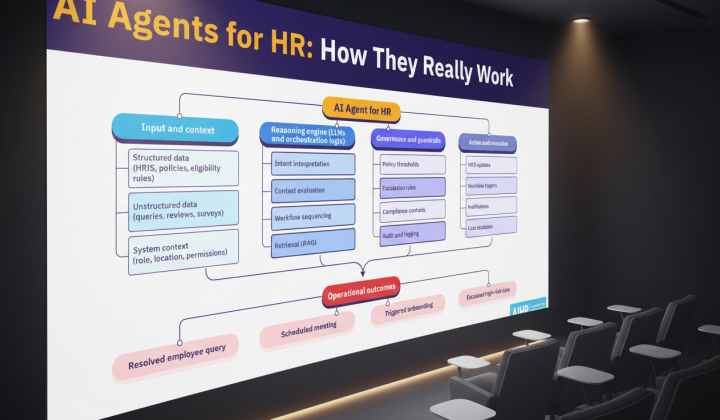
While still an emerging technology, leading organizations are already deploying AI agents for real-world HR scenarios. These systems are built on technologies like Large Language Models (LLMs) and, in some cases, Retrieval-Augmented Generation (RAG), enabling them to independently manage and execute complex HR processes.
Early adopters are reporting substantial gains. For example:
- AMD reduced query resolution time by 80%, increased self-service adoption by 50%, and boosted employee satisfaction by 70% after implementing an AI agent.
- Beacon Mobility reported 60% automatic query resolution, 97.5% customer satisfaction, and over 2,000 hours of employee work saved thanks to its agent, Beacon Buddy.
- Great Wolf Lodge saw a 423% increase in scheduled interviews and saved $700,000 in annual job advertising costs using its AI assistant, Emma.
The impact of AI agents in HR is profound. They not only improve task execution at scale but also provide early insights and enable proactive intervention. This is leading to a redefinition of HR roles, with a greater focus on high-value strategic work. The implementation of AI systems creates a more resilient HR operational model, allowing for efficient process management, cost reduction, and enhanced overall service delivery.
Consequently, AI agents are becoming a crucial tool that is reshaping the HR profession, enabling specialists to concentrate on strategic objectives and improve organizational effectiveness.
The adoption of AI agents in HR has the potential to fundamentally alter talent management approaches by streamlining routine operations and boosting their efficiency. This is particularly vital in today's competitive labor market, where speed and quality of service are decisive factors in attracting and retaining skilled talent. The continued advancement of AI technology in HR promises even greater opportunities for optimizing this critical business function.

Read also