How and why Putin's Russia invented the Ukrainian threat - Alexander Motyl

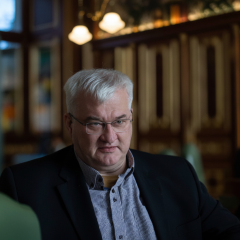
Opinions in the European publication EUObserver by American political scientist and historian of Ukrainian descent Alexander Motyl
As discussions about 'security guarantees' for Russia come full circle again, it is important to remember that Ukraine has never posed, does not pose, and will not pose a threat to Russia's security. Even if it joins NATO in the near future.
Ukraine is only important to Russia's security interests because the Russians themselves turned it into a significant interest in their security strategy. If that is the case, the Russians could just as easily 'destroy' it and instead treat Ukraine no more than a neighbor.
Russians see a threat where there is none because they have built an imperial worldview that turns Ukraine into a threat
What Vladimir Putin and his entourage think about Ukraine has little to do with reality and entirely with ideology. Russians see a threat where there is none because they have built an imperial worldview that turns Ukraine into a threat.
Let's consider some obvious facts.
The Russian Federation is the largest country in the world with a population of 145 million people. Ukraine occupies much less territory, and its current population is likely around 30 million people. That's one-fifth of Russia's population.
READ ALSO: 'Russia will lose, but will not want to sign any peace agreement' Valentin Krasnoperov
Russia has thousands of nuclear weapons. Ukraine has none. Russia has a vast, though less combat-ready army. Ukraine has a fifth less of an army.
Russia has virtually unlimited energy resources. Ukraine does not.
Russia is a permanent member of the UN Security Council. Ukraine is not.
Overall, Ukraine poses as much of an objective threat to Russia as Canada does to the USA.
READ ALSO: 'Victory next year is an optimistic prospect' Konrad Muzyka
This gross imbalance of power resources was even greater in the past when Ukrainians had neither a state, nor an army, nor an economy of their own.
Unless there is a collapse of Russia, there are absolutely no grounds to believe that Ukraine will suddenly surpass Russia in strength and become a threat to it in the near future.
This would be true even if Ukraine were to join the Alliance. Currently, NATO members Norway, Finland, Poland, and Lithuania border the Russian Federation. The Kremlin rarely speaks out against the supposed threat that any of them poses to Russia. It would have no objective grounds to consider Ukraine as such.
NATO does not represent an objective threat to Russia's security. Most of its members have completely forgotten about their armed forces since the collapse of the USSR in 1991
Even NATO does not represent an objective threat to Russia's security. Most of its members have completely forgotten about their armed forces since the collapse of the USSR in 1991.
European populations do not wish to fight, and their political elites began to think strategically only after Russia's invasion of Ukraine. Yes, the USA represents an objective threat to Russia, but has always been and will always be. To neutralize the threat posed by both sides to each other, discussions need to be about the strategic nuclear arsenals possessed by Russians and Americans, rather than about security guarantees.
If Ukraine does not clearly present a threat, nor could it be a threat even if it wanted to, why do modern Russian elites see it as such?
READ ALSO: 'Russia's last attack is an argument to supply more air defense systems' Juliusz Sabak
Historically, both the Moscow and Russian elites have regarded the territories that make up modern Ukraine with indifference or greed, rather than fear. Ukraine was too far away to matter to the rising Moscow state, which in the 12th-15th centuries was engaged in fighting the Mongols and destroying the Novgorod Republic.
In the following two centuries, Moscow conquered Siberia. The issue of Ukraine arose in the 16th-17th centuries when it became a bone of contention between Poland and Muscovy.
Only in 1709, when Ukrainian Cossack leader Ivan Mazepa forced several thousand of his soldiers to fight alongside Swedish King Charles XII, did Ukraine present a tiny threat to the vast empire of Peter I.
But the Swedes lost at Poltava, and after that, Ukrainians remained without citizenship until 1991. Even though their country was a target for competing imperialisms, particularly Ottoman, Russian, Austrian, and German, in three partitions of Poland and two world wars.
Russia's denial of Ukraine's right to exist as a separate nation and state goes back centuries and persisted, with slight changes, during the Soviet period. The statement that Ukraine poses a deadly threat to Russia is a new invention of the Putin era, although it has roots in Stalin's campaign of genocide against Ukrainians in the early 1930s. Here is the logic of this illogicality.
Putin considers the collapse of the USSR to be the greatest geopolitical tragedy of the 20th century. He openly sees the Soviet Union and Imperial Russia as predecessors of modern Russia. He has fully absorbed the viewpoint that the Russian Federation must be great and powerful. And he has made these ideological demands central to his own legitimacy.
Given such thinking, it is no surprise that he has begun 'collecting' former Soviet or imperial Russian territories - Belarus, a piece of Moldova known as Transnistria, southeastern Ukraine, and two parts of Georgia.
So far, maybe something else is ahead, which Estonians, Latvians, Lithuanians, Poles, and Kazakhs fear.
Belarusian dictator Alexander Lukashenko has voluntarily submitted to Russian hegemony. Moldova and Georgia are too small to disrupt Putin's project. Ukraine, on the other hand, is a key factor.
Its steadfast resistance to absorption by Russia has been ongoing since 1991, so much so that Ukrainians have staged two democratic revolutions in defense of their sovereignty and are now fighting for their survival against Putin's army.
Ukraine's resistance and the very existence of this independent country threaten Putin's imperial project
Thus, the resistance of Ukraine and its very existence as an independent Ukraine represent a threat to Putin's imperial project - not because they genuinely threaten the existence of Russia, but because they are perceived by Putin as a threat to his existence and the existence of his imperial project.
This means that all discussions about security guarantees for Russia are nonsense. The West would do well to ask the Kremlin which of its immediate neighbors, excluding China, Moscow's fair-weather ally, seriously threatens Russia's security.
The West should provide security guarantees to those countries facing a deadly threat to existence: Ukraine, Kazakhstan, and Belarus
Instead, security guarantees should be provided to those countries that truly face a deadly threat to their existence - Ukraine, Kazakhstan, and Belarus.
The only good news is that since the view of Ukraine as a threat is a product of Kremlin imagination, there is hope that over time, Putin's successors will rid themselves of their imperial delusions and start treating Ukraine as they should - as a neighbor.
Translation by Gazeta.ua

Read also