Anatomy of the Peace Agreement: Five Points That Could Determine the Future of the War
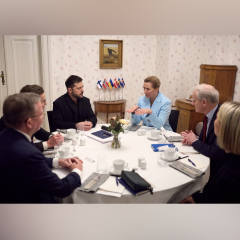
While public spaces fill with statements about the proximity of peace, diplomatic consultations gradually shift to more complex issues: where the line of demarcation will be, who will control the ceasefire, what will happen to the Zaporizhzhya Nuclear Power Plant, and what guarantees Ukraine will receive. At the center of attention is possible negotiation formats involving American military and diplomatic representatives, including General Alexus Grinkevich, Steve Witkoff, and Jared Kushner. However, the specific parameters of the future agreement remain unconfirmed. Five scenarios being discussed among experts allow us to understand not so much the content of the finalized agreement as the logic behind a possible cessation of hostilities.
'A peace agreement is not just a decision to stop shooting. It is a system of rules that must define what happens the next day after the last shot.'
1. Demilitarized Zone: Who Will Control the Silence?
The first and perhaps the most difficult element of a potential agreement is the creation of a demilitarized zone along the line of combat engagement.
One potential scenario involves a strip 20-50 kilometers wide within which the parties would have to limit the placement of heavy artillery, armored vehicles, and other offensive systems.
However, these parameters should not be taken as already agreed negotiation conditions.
Technically, such a design could reduce the risk of a sudden large-scale offensive. But its effectiveness will depend on who will control the implementation of the agreements.
A model is being considered in which instead of a large NATO peacekeeping contingent, a two-level observation system would be used: American satellites and reconnaissance drones would provide technical monitoring, and representatives of third countries would conduct inspections on the ground.
Potential participants in such a mechanism could theoretically include the UAE, Saudi Arabia, or Brazil. However, their readiness for such a mission would require separate confirmation.
The main problem is that observation does not equate to enforcement of the agreement.
A satellite can record the movement of military equipment. An inspector can establish the fact of a violation. But neither of these tools is capable of stopping a new offensive on its own.
Therefore, the crucial question will be accountability for violations of the ceasefire regime.
2. Zaporizhzhya Nuclear Power Plant: Energy as an Item of Compromise
The second possible block is the future status of the Zaporizhzhya Nuclear Power Plant.
The largest nuclear power plant in Europe has been under Russian control since March 2022. Its safe operation, ensuring external electricity supply, and access for international experts remain critically important issues.
One hypothetical scenario suggests a special international technical management mechanism involving the IAEA and specialists from third countries.
In such a structure, the plant could receive a separate security regime, and the produced electricity would be distributed between the Ukrainian energy system and territories controlled by Russia.
The idea of sharing power in a 50-50 ratio may seem attractive to negotiators looking for a symmetrical compromise. However, there is no reason to consider it an agreed formula.
Moreover, the IAEA primarily has a mandate in nuclear safety, guarantees, and technical monitoring. Transferring full operational functions of the power plant to the agency would require separate legal and organizational decisions.
There is also a fundamental contradiction: the plant is a Ukrainian facility, so any international management model must consider issues of sovereignty, ownership, and accountability for nuclear safety.
The Zaporizhzhya NPP could become one of the central elements of a peace compromise. But it cannot be viewed merely as a power plant whose capacity is sufficient to divide in half.
3. De Facto vs. De Jure: Peace Without Legal Recognition of Borders
The third block concerns the most sensitive issue - territories.
A possible diplomatic formula suggests a distinction between actual control and legal recognition.
Ukraine does not recognize the loss of sovereignty over the occupied territories. Russia retains actual control over certain areas at the time of the cessation of hostilities, but this does not mean international recognition of its territorial claims.
Such constructions are known in international practice.
Cyprus remains one example of prolonged territorial division without widely recognized legal settlement. However, the Cypriot model also demonstrates that freezing the conflict can last for decades without addressing its political causes.
For Ukraine, such a formula could allow for cessation of large-scale hostilities without formally renouncing territorial claims.
For Russia, it would mean the possibility of retaining actual control over occupied territories without full international recognition.
Sanctions and frozen Russian assets could potentially become a separate subject of negotiations.
However, step-by-step unfreezing of assets cannot be an automatic adjunct to the agreement between Washington and Moscow. A significant portion of the relevant funds is located in European jurisdictions, and decisions regarding their status depend on the laws and political will of the respective states.
Thus, the territorial issue will inevitably be linked to the broader international sanctions regime.
4. The Israeli Model: Guarantees Without NATO Membership
The fourth possible element is an alternative security guarantee system.
Instead of rapid accession of Ukraine to NATO, a model of long-term bilateral defense partnership with the United States may be discussed.
This is conditionally called the Israeli model, although US-Israel relations do not provide for automatic American military intervention analogously to Article 5 of the North Atlantic Treaty.
For Ukraine, such a structure could include long-term arms supply programs, joint production, intelligence data exchange, military training, and funding for defense needs.
A separate mechanism could be a snap-back system - automatic or accelerated re-establishment of restrictive measures in case of violation of the agreements.
For instance, new Russian aggression could trigger additional sanctions or increased military support for Ukraine.
However, the automaticity of such a mechanism would depend on its legal structure. Decisions regarding sanctions and military supplies in the US and Europe are made by various authorities, and some of these require legislative procedures.
Therefore, guarantees that exist only in the form of political promises may prove inadequate.
The most crucial question is whether future agreements can ensure the fulfillment of obligations regardless of changes in administrations in Washington.
5. Russia - NATO 2.0: Returning to Arms Control
The fifth block extends well beyond Ukraine.
It concerns the potential revival of military communication mechanisms between Russia and NATO, as well as discussions on limitations on the deployment of certain offensive systems near borders.
In theory, this could involve agreements on intermediate-range missiles, transparency measures, advance warning of military exercises, and the establishment of operational communication channels to prevent dangerous incidents.
Direct contacts between military structures could reduce the risk of accidental escalation.
However, creating a special channel between American military structures in Europe and Moscow would not mean an automatic restoration of full political dialogue between Russia and NATO.
Moreover, any limitations on the deployment of weapons in Eastern Europe would touch upon the interests of Poland, the Baltic States, Romania, and other NATO members.
Agreeing on a new arms control system without their participation would be politically complex.
Especially considering that European states have significantly reassessed the Russian military threat after 2022.
The future security architecture cannot be stable if it is created solely by two major powers, while the entire continent has to implement it.
Not a Peace Treaty, but the Engineering of a Strategic Pause
All five blocks share one logic: they are primarily aimed at managing risks after a possible cessation of hostilities.
A demilitarized zone should reduce the probability of a sudden offensive. A special status for the Zaporizhzhya NPP should eliminate nuclear risks. The de facto/de jure formula should allow for deferring the final resolution of territorial issues. Bilateral guarantees should provide Ukraine with means of deterrence. Military channels between Russia and NATO should reduce the risk of broader confrontation.
However, none of these mechanisms alone resolves the fundamental political contradictions between the parties.
That is why the future agreement, if reached, may resemble a complex system of conflict management more than a final peace treaty.
At the same time, there is currently insufficient open confirmation that these five parameters already constitute an agreed negotiating document in Abu Dhabi. It is more appropriate to consider them as a possible framework for settlement rather than established content from closed consultations.
The Main Challenge - The Day After the Ceasefire
International diplomacy has repeatedly demonstrated the ability to negotiate ceasefires. Ensuring compliance with agreements a year, five, or ten years later is significantly more challenging.
In the case of Ukraine, this issue holds special significance.
If cessation of hostilities allows both sides to restore military potential without reliable deterrence mechanisms, the risk of a new clash will remain high.
However, if the agreement ensures effective control, predictable guarantees, and real accountability for violations, it could become the basis for longer-term stabilization.
By 2030, the outcome will depend not so much on diplomatic formulations as on three factors: Ukraine’s ability to maintain its own defense capability, the readiness of partners to fulfill long-term obligations, and the price that Russia will pay for possible violations of the agreements.
A peace agreement can stop the war on paper. But only a real balance of power and deterrence mechanisms can prevent its return.
This is the main contradiction of the potential negotiation process. Diplomats may create a legally complex structure, distribute responsibilities among dozens of participants, and anticipate procedures for responding to every possible incident.
However, no document compensates for the absence of political will to fulfill the obligations undertaken.
And if a technical framework for future settlement is indeed forming in Abu Dhabi, its primary criterion will not be the number of agreed points, but the answer to one question: will this structure make the next war less likely - or merely allow the sides to prepare for it better?

Read also