Rare Bowl and Two Female Figurines Unearthed by Archaeologists at the Etruscan City of Kainua

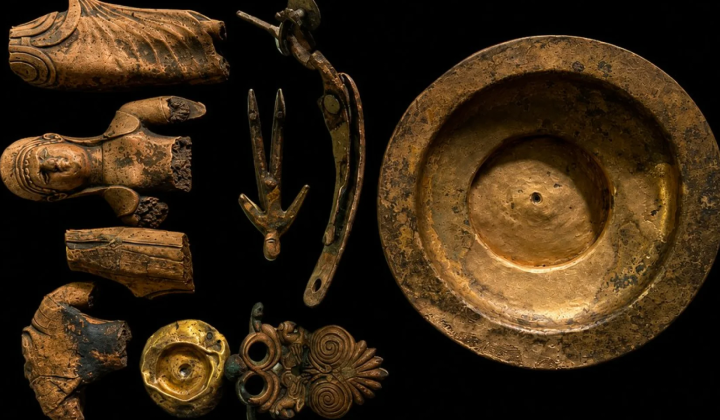
Artifacts Unearthed at Kainua
According to НВ — Техно: At Kainua, an Etruscan city near modern-day Marzabotto in northern Italy, archaeologists have uncovered a cache of well-preserved bronze objects. The Etruscan civilization, which preceded Rome and had a deep influence on it, remains a central subject of archaeological study. The find comprises two female statuettes and a rare bronze bowl. The artifacts are thought to date from the late sixth to early fifth century BCE and likely belonged to a sacred ritual well. The same well also held the remains of two adults.
After nearly 2,500 years underground, the bronzes still retain much of their original metallic appearance. The well that held them lies in Kainua's sanctuary district, where two large temples have previously been uncovered. Etruscan inscriptions identify these temples as sacred to Tinia and Uni. Tinia-also known as Tins-was regarded as the supreme sky god, and Uni was his consort.
Kainua's Historical Importance
Founded in the late sixth century BCE, Kainua grew into one of the Po Valley's leading Etruscan centers. Situated beside the Reno River, the town developed into a key hub for metalworking and commerce, with goods such as bronze and iron passing through it. Kainua flourished for roughly two centuries before being abandoned around the middle of the fourth century BCE. Rediscovered in the nineteenth century, the site has been under excavation by the University of Bologna since 1988.
The newly recovered objects are expected to join the collections of the National Etruscan Museum in Marzabotto. Because no later urban development was built over Kainua, its archaeological landscape remains remarkably intact, giving researchers the opportunity to keep investigating this significant historical site.
The discoveries at Kainua highlight the importance of the Etruscan civilization to Italy's history and the lasting cultural influence it had on the later Roman Empire.
These preserved finds will allow scholars to learn more about Etruscan religious rituals, social organization, and metalworking expertise. Since Kainua is one of the rare sites where archaeological layers have survived almost untouched, this discovery represents a significant step forward in the study of Etruscan archaeology and culture.

Read also