Archaeologists Established the Scandinavian Origin of the Vampire Zosia

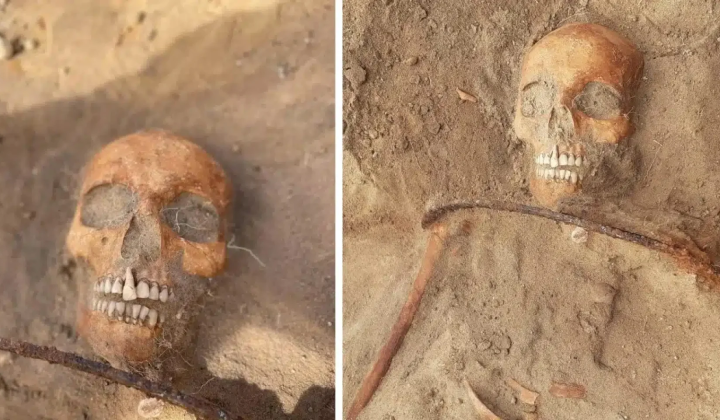
Study of the Remains of the Vampire Zosia
According to НВ — Техно: August 13, 21:00
An international team of archaeologists and anthropologists has published a study on the remains of the so-called Vampire Zosia from the Polish village of Pień. According to the findings, the girl had Scandinavian origins, grew up in Poland, and belonged to a higher social status. Two stages of anti-vampire rituals were conducted over Zosia's body. A triangular lock was found on her toe, and an object with a high copper content was placed in the deceased's mouth, leaving green traces on the palate, the base of the skull, and the cervical vertebrae. Scientists excluded the possibility that this object was a coin.
An iron sickle found near Zosia's neck was discovered during the reopening of the grave, not during the initial burial. At the time of the reopening, the soft tissues of the body had not yet decomposed. Genetic analysis confirmed Zosia's Scandinavian roots, while isotopic studies showed that she grew up in Poland and was a second-generation migrant. Remnants of a silk ribbon made of silver and gold threads were found around the deceased's jaw, indicating her wealthy descent.
Scientific Research and Its Results
A scientific team led by Professor Dariusz Poliński from Nicolaus Copernicus University discovered 101 burials at the cemetery in Pień, which is the largest similar necropolis in Poland. Colleagues from the United Kingdom and the United States also participated in this research. At least 12 of the 101 burials contain traces of occult precautions, indicating ancient traditions and superstitions.
The research also revealed that Zosia had a hemangioma - a vascular tumor in the chest causing pain and visible deformity of the thoracic cage. These factors may explain the extraordinary attention given to her burial and the rituals associated with it. In the 17th century, due to fear of epidemics, people were buried with mutilated limbs, skulls pierced by metal rods, or faces buried deep in the ground.
The research findings were published in the Journal of Archaeological Science: Reports.
This discovery highlights the importance of studying ancient burials to understand the social and cultural aspects of life in past eras.
The study of Zosia's remains and the associated burials at the cemetery in Pień opens new horizons for understanding social structures and cultural perceptions in medieval Poland. In particular, the discovery of anti-vampire rituals indicates fears and superstitions that may have existed in society at that time. Such findings allow for a better understanding of how past generations responded to unusual or painful phenomena, as well as how they shaped their traditions and rituals.

Read also