Discovery of the Hydrogen-Rich Dark Galaxy AGC 322753 Located 310 Million Light-Years Away

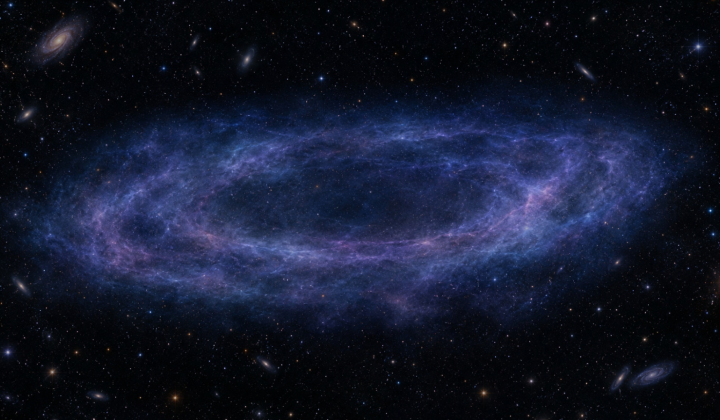
Unveiling the Dark Galaxy AGC 322753
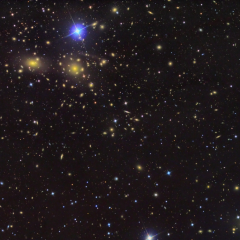
According to Radiotrek — Світ: Astronomers have identified a potential dark galaxy packed with a massive reservoir of hydrogen gas. The object, known as AGC 322753, lies roughly 310 million light-years from Earth. Despite containing about 2 billion solar masses of neutral hydrogen, this galaxy shows no detectable starlight, making it a rare and intriguing find. The discovery was led by Marco Monaci of Swinburne University of Technology in Australia.
How the Galaxy Was Detected
The team used observations from the Arecibo Observatory in Puerto Rico and China’s FAST radio telescope to detect the galaxy. Both facilities recorded consistent signals from AGC 322753, confirming the presence of large amounts of neutral hydrogen. The gas appears to be rotating within a disk, a feature that sets AGC 322753 apart from the 13 other dark galaxy candidates, highlighting its uniqueness.
Why is this discovery significant? Further observations are necessary to verify the presence of faint stars and to better understand the behavior of the gas within AGC 322753. Dark galaxies like this one, which lack visible starlight, are notoriously difficult to study but could provide crucial insights into the nature of dark matter and galaxy formation. With its enormous hydrogen content, AGC 322753 holds the raw material potentially needed for star formation in the future.
"AGC 322753 opens new avenues for astronomical research and underscores the critical role of advanced radio telescopes in exploring the cosmos." - Marco Monaci
This finding has the potential to deepen our comprehension of dark galaxies and their influence on cosmic evolution. Studying such elusive objects may shed light on dark matter, one of the greatest mysteries in contemporary astronomy. Continued investigations could confirm or challenge current theories about star formation in dark galaxies, ultimately enriching our understanding of the universe’s structure.
As researchers continue to explore the depths of our universe, the recent identification of AGC 322753 highlights the importance of such discoveries in understanding cosmic phenomena. In a related context, the confirmation of the powerful radio galaxy TXS 2354+015 offers valuable insights into the dynamics of ancient galaxies, further enriching our comprehension of how these celestial bodies evolve over billions of years.

Read also