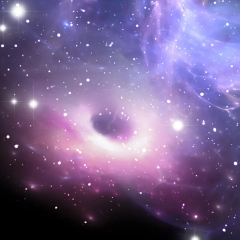
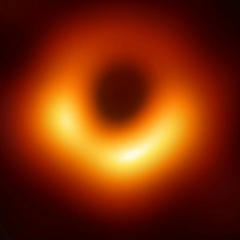
How the Supermassive Black Hole in 3C 120 Simultaneously Swallows Matter and Launches Near-Light-Speed Plasma Jets

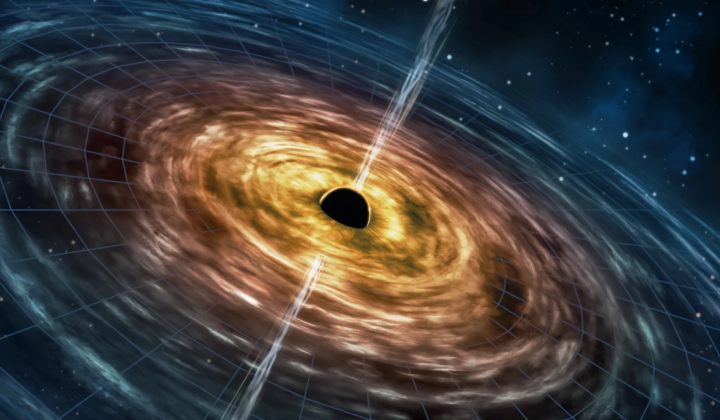
Jets Approaching the Speed of Light
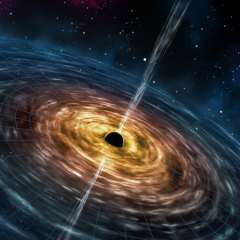
According to НВ — Техно: Researchers have uncovered new insights into the mechanisms powering powerful plasma jets produced by supermassive black holes. The black hole at the center of galaxy 3C 120 is observed to be both accreting matter and ejecting streams of plasma at velocities close to the speed of light. Their findings reveal that the cold accretion disk does not extend all the way to the event horizon; instead, an inner region filled with extremely hot plasma surrounds the black hole, where intense magnetic fields accumulate. These magnetic fields are believed to play a crucial role in launching the relativistic jets.
Unveiling the Black Hole's Environment
Located within the Taurus constellation, the supermassive black hole in 3C 120 is encircled by a cold disk whose inner edge lies roughly 20 times the black hole's radius away. Closer inward, astronomers detected a scorching plasma region with temperatures reaching hundreds of millions of degrees. This boundary of the cold disk was determined through detailed analysis of iron emission lines in X-ray spectra.
The study combined observations from the XRISM X-ray space observatory with radio data gathered by the Global Millimeter VLBI Array, the Very Long Baseline Array, and the East Asian VLBI Network. This multiwavelength approach allowed scientists to trace the narrowing plasma jet as it emerges from the black hole's vicinity.
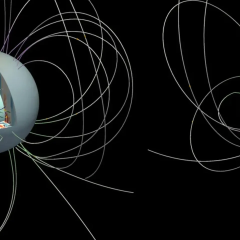
The ultrahot plasma zone appears capable of storing powerful magnetic fields that may tap into the black hole's rotational energy to fuel the jets. However, current data do not conclusively demonstrate that the black hole's spin energy directly powers the outflows. To deepen understanding, researchers plan to investigate a more massive black hole using XRISM and radio telescopes, aiming to compare observations with theoretical models and advanced computer simulations.
This new research on 3C 120 emphasizes the importance of exploring jet formation processes, which are pivotal for grasping how galaxies evolve and influence their cosmic environments. Continued observations promise to uncover further details about these phenomena and may help resolve longstanding questions in modern astrophysics.
In addition to the fascinating dynamics of black holes, recent research has also revealed an intriguing pattern in black hole masses that suggests a new mechanism for star formation. This study indicates that some stars might collapse into black holes without undergoing the typical supernova explosion. To explore this unexpected phenomenon further, read more about the unusual mass distribution of black holes and its implications for our understanding of stellar evolution.

Read also