For the first time, astronomers have precisely mapped the outer boundary of the Universe's largest known galaxy

The edge of a cosmic giant finally comes into focus
According to НВ — Техно: Publication date: August 3, 08:30
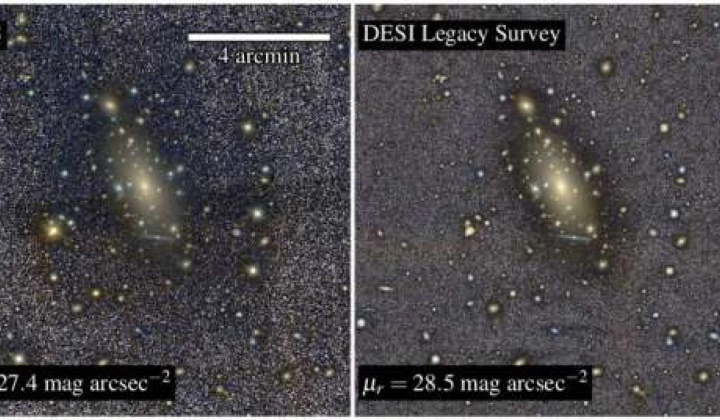
An international team of astronomers, headed by Carlos Marrero de la Rosa from the Institute of Astrophysics of the Canary Islands, has for the first time obtained a precise measurement of the outer edge of IC 1101, a galaxy located in the Abell 2029 cluster. This achievement reinforces IC 1101's standing as the biggest galaxy ever observed. Its radius spans 260 kiloparsecs, giving it a diameter of roughly 520 kiloparsecs, or about 1.7 million light-years. By comparison, the Milky Way measures around 30 kiloparsecs across, so IC 1101 is nearly 17 times wider than our own galaxy. Knowing the true extent of such an extreme object helps astronomers refine their models of galaxy formation and evolution.
What the study uncovered
To create the most detailed images of IC 1101 ever taken, the researchers used data from the wide-field camera on the Isaac Newton Telescope (INT). A major breakthrough came from separating the galaxy's faint luminous halo from the glow of more than 250 foreground stars, which allowed for highly accurate measurements. The estimated total stellar mass of IC 1101 is 3.4 trillion times the mass of the Sun.
The images also show eight massive, dim stellar structures extending beyond the galaxy's main boundary. Two of these structures line up with previously detected X-ray oscillations in the hot gas of the cluster, suggesting that IC 1101 is still actively growing. The study further confirms that IC 1101 began merging with another galaxy group roughly 2 to 3 billion years ago.
The findings have been published on the arXiv preprint server under DOI: 10.48550/arxiv.2607.15340. They offer new details about the structure and evolution of the most enormous galaxies in the cosmos and highlight the importance of modern astronomical instruments in exploring the Universe.
This work represents a significant step forward in understanding galaxies and how they change over time, while also demonstrating the powerful technology now available for obtaining ever more exact data about distant objects. The measurements of IC 1101 could provide a foundation for future studies of how galaxies interact and take shape within vast galaxy clusters. The results may carry broad implications across the astronomical community, opening new avenues for research in astrophysics and beyond.
In addition to this groundbreaking discovery, recent research has also identified a spiral-armed galaxy from the early Universe that challenges existing cosmological theories. This finding could provide further insights into the formation and evolution of galaxies, complementing the understanding gained from studying IC 1101.

Read also