Brussels found the money: how the new loan for Ukraine is being transformed into a financial triumph


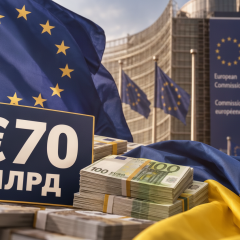
The European Commission is seeking a mechanism to cover Ukraine's financial needs for 2027, estimated at around €70 billion. In the headlines, this is already being called a breakthrough. However, between political intent, permission to borrow, and the actual arrival of funds, there lies a distance that European bureaucracy traverses over years. Brussels demonstrates readiness to support Kyiv, but the main question remains open: who will provide the money, under what conditions, and who will ultimately pay off the debt?
«In European finance, finding money increasingly means finding someone willing to lend it under future budgetary commitments».
Money found. Now it remains to borrow it
European bureaucracy has a special talent: turning complex financial negotiations into optimistic political messages. When headlines proclaim that the European Union has found a way to cover Ukrainian needs for €70 billion, one can imagine that Commission President Ursula von der Leyen descended to the basement of the Berlaymont building and discovered a forgotten reserve fund.
The reality is significantly more mundane.
According to reports from Rapporteur and Brussels Signal, additional financing mechanisms for Ukraine are being considered in internal discussions within the European Commission, including the possibility of new joint borrowings.
In other words, this is not about the already available €70 billion that can be immediately transferred to Kyiv, but rather about a potential debt structure that will require political approval, legal formalization, and the determination of repayment sources.
However, the assertion that the EU does not have this money at all would also be an oversimplification. The European Union possesses significant financial capacity, has access to international capital markets, and employs various budgetary support instruments. The problem is not in the absolute lack of resources, but in the fact that attracting them requires the consent of member states and creates future commitments.
The issuance of European bonds does not automatically mean the approval of a new loan. Depending on the legal structure, separate decisions may be required regarding budgetary guarantees, debt limits, and financing mechanisms. The requirement for unanimity across all 27 states also depends on the chosen procedure and does not automatically apply to any European borrowing.
It is precisely at this stage that political unity often comes into conflict with national budgetary interests.
The mathematics of generosity: two-thirds of what is needed
According to information attributed to Brussels Signal, the European Commission is considering a scenario where the EU will provide approximately two-thirds of the necessary financing for Ukraine – around €45–47 billion.
The remaining funds are expected to be mobilized from international partners, primarily from G7 countries, including the United Kingdom, Canada, and Japan.
On paper, this model looks logical. Europe takes on the bulk of the financial burden, while other partners supplement the package, spreading risks among several economies.
But here three problems arise immediately.
Firstly, political readiness to provide funding does not yet mean that the corresponding funds have been allocated in national budgets.
Secondly, different donors may offer fundamentally different instruments: grants, bilateral loans, guarantees, or financing through international organizations. For Ukraine, these forms of assistance have different consequences.
Thirdly, even agreed packages may arrive in parts, depending on the fulfillment of established conditions.
At the same time, it should not be assumed that the UK, Canada, and Japan can act solely with Washington's permission. These countries have their own budgetary procedures and political interests. The American position can influence the scale of joint support, but it does not automatically determine every decision made by other G7 members.
The problem of €70 billion is not only about finding creditors. It is also about ensuring that their promises can be turned into timely payments.
The summit as a financial instrument of deferred decision
Reports of a possible special EU summit on November 26-27 fit into the usual practice of European negotiations: when a complex financial issue fails to be resolved at the current meeting, it is deferred to the next political level.
On the one hand, this may appear as bureaucratic procrastination. On the other hand, multilateral financial decisions indeed require time to coordinate among governments, the European Commission, the EU Council, and other institutions.
Especially when it comes to tens of billions of euros in new commitments.
Attempts to link the calendar of European negotiations with diplomatic contacts of the US and China should also be approached with caution. Washington and Beijing influence global financial markets, trade policy, and the geopolitical environment, but mere coincidence of dates does not prove that Brussels is consciously postponing decisions until the completion of US-China consultations.
What is much more important is the internal conflict between two approaches to funding.
One group of states supports the expansion of joint European borrowing instruments. The other fears that such mechanisms will gradually become a permanent practice of collective debt.
For countries with stricter budgetary discipline, this issue goes far beyond assistance to Ukraine. It concerns the future model of the European Union itself: whether it will remain a union of primarily national budgets or increasingly use common debt instruments.
Therefore, negotiations about Ukrainian financing simultaneously become negotiations about European financial integration.
Ninety billion in promises: where politics ends and finance begins
A separate point of attention is the already agreed support package for Ukraine amounting to €90 billion.
In reports about internal documents of the European Commission, there is a mention of the requirement to accelerate reforms and ensure compliance with the conditions of existing financial programs. At the same time, an assessment notes that actual payments under the corresponding mechanism currently amount to about €20 billion.
If these figures are confirmed by official reporting, they will demonstrate a significant difference between the announced volume of the program and the funds actually disbursed.
However, comparing the total multi-year package with payments for an incomplete period without taking into account the schedule of tranches is incorrect. The unpaid part does not necessarily mean a delay: funds may be planned for the following years or depend on the fulfillment of agreed conditions.
For this reason, three separate indicators are needed to assess the effectiveness of European support: the total amount of commitments, the volume of funds scheduled for disbursement on a specific date, and the payments actually made.
Without this, even correct figures can create a misleading impression.
The European Commission also links financial support with reforms in public administration, anti-corruption systems, the judiciary, and economic institutions in Ukraine. For Brussels, this is a way to monitor the use of funds and reduce risks. For Kyiv, it represents an additional administrative burden in wartime.
«A promised billion has political value. A disbursed billion has economic value. And a billion that arrives on time can have strategic significance».
Who will ultimately pay for European solidarity?
The least noticeable, but fundamentally important question is the future cost of new borrowings.
If the EU raises funds in international markets, investors gain the right to interest payments and repayment of the principal amount of the debt. Who will bear these costs depends on the structure of the financial instrument.
In one case, obligations may be covered by the EU budget. In another, repayment may be tied to revenues from frozen Russian assets. Combined models with guarantees from member states are also possible.
This is not a technical detail, but a central question of the entire financial architecture.
A grant means non-repayable support for Ukraine. A typical loan creates a debt obligation. A loan secured by specific external revenues has a different economic risk profile.
Therefore, the mere fact of a new European borrowing does not allow one to determine how beneficial or burdensome it will be for Ukraine.
Important conditions, not just the headline amount.
Europe between financial capacity and political will
Brussels indeed has the instruments that allow mobilizing tens of billions of euros. The European Union remains one of the largest economic unions in the world, and its creditworthiness allows it to attract significant resources in international markets.
But financial capacity is not synonymous with political decision.
New support programs for Ukraine require not just declarations, but also agreed sources of funding, legal mechanisms, payment schedules, and risk distribution.
This is where the boundary lies between informational optimism and real economic policy.
To call the discussions of a new loan a definitive financial breakthrough is premature. Likewise, it is premature to assert that Europe is merely simulating support: existing mechanisms already provide Ukraine with significant financial resources, although their mobilization and use are accompanied by complex procedures.
The main test for the EU lies elsewhere – whether it can transform large political commitments into a predictable system of long-term financing.
In Brussels, they are currently searching not for a suitcase with €70 billion, but for the formula by which this money can be borrowed, distributed, and repaid.
And this is a crucial difference. In state finances, an open credit line does not yet equate to money in the account. And a political promise has not yet settled the bill.
Editorial note: The stated parameters of the new financial proposals and individual amounts of payments reflect initial reports but have not been independently verified against official documents from the European Commission. Their status and funding schedules should be verified before being published as confirmed facts.

Read also