CERN Recreates Cosmic Particle Showers for the First Time Using the Large Hadron Collider

Bringing Outer Space Inside CERN’s Tunnel
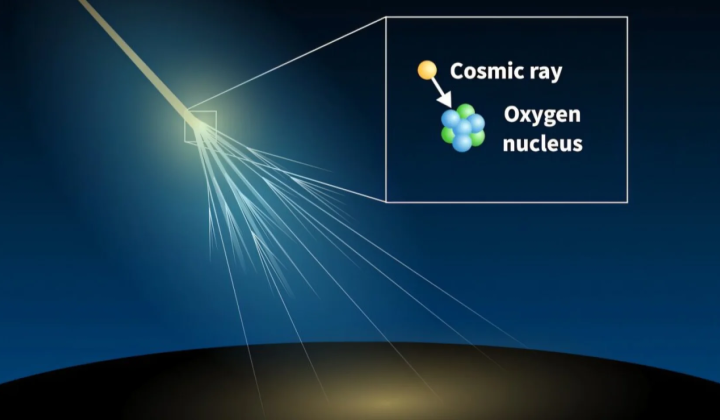
According to НВ — Техно: Scientists at CERN have successfully simulated cosmic particle showers in a laboratory setting for the first time. By colliding protons with oxygen nuclei inside the Large Hadron Collider (LHC), researchers recreated the complex cascades of particles that occur when cosmic rays interact with Earth's atmosphere. These groundbreaking results provide more accurate insights into particle cascade processes and will help clarify the ratio of hydrogen to heavier elements in primary cosmic rays.
Unraveling the Mystery of Cosmic Rays
Cosmic rays consist mainly of ultra-fast atomic nuclei, predominantly hydrogen, which strike the atmosphere at the edge of space, triggering a chain reaction that produces a shower of secondary particles. At the LHC, a proton beam acted as the cosmic ray, while oxygen ions represented Earth’s atmospheric nuclei. The ATLAS detector, roughly the size of a football field, captured these collisions with incredible precision. Its silicon sensors generate over 200 million data frames daily, enabling detailed observation of these high-energy interactions.
The measurement accuracy achieved exceeds previous computer simulations by a factor of ten, marking a significant advancement for astrophysics. Prior ground-based observatories, such as the Telescope Array in Utah’s desert, have studied cosmic rays but faced conflicting model predictions about how particle showers develop. CERN’s new data promises to refine these models, deepening our understanding of how cosmic rays form and interact with our atmosphere.
This achievement highlights the vital role of controlled laboratory experiments in studying vast astrophysical phenomena. Enhanced data from CERN will empower scientists to better comprehend the composition and behavior of cosmic rays, potentially influencing future astrophysical theories and expanding our knowledge of the universe.
In addition to these laboratory breakthroughs, recent findings have also shed light on the ancient radio signals emanating from neutral hydrogen, which have been traveling to Earth for billions of years. This discovery not only complements CERN's advancements in understanding cosmic phenomena but also highlights the ongoing quest to decode the universe's history. For more insights into this fascinating area of research, explore how astronomers are uncovering ancient cosmic messages.

Read also