Voyager 1 Becomes First Human-Made Object to Reach One Light-Day from Earth, Exiting the Heliosphere

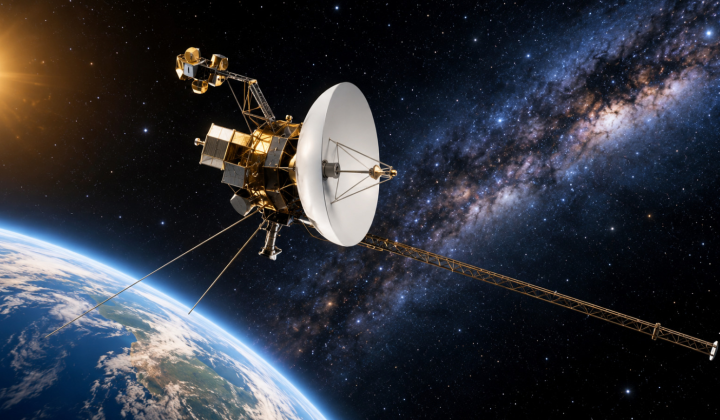
Voyager 1's Historic Milestone
According to Radiotrek — Світ: Launched by NASA in 1977, the Voyager 1 spacecraft achieved a groundbreaking feat on November 18, 2026, when it reached a distance of one light-day from Earth-approximately 25.9 billion kilometers. This milestone marks Voyager 1 as the first human-made object to leave the heliosphere, the vast bubble of charged particles surrounding our solar system. Even as its onboard power gradually diminishes, the probe continues to send valuable information about the interstellar environment back to Earth.
Scientific Exploration and Instruments
Traveling at a speed of about 61,100 km/h, Voyager 1 initially conducted detailed studies of Jupiter in 1979 and Saturn in 1980. Today, two scientific instruments remain operational, gathering data on magnetic fields and plasma waves in deep space. NASA aims to maintain communication with Voyager 1 into the early 2030s, although the immense distance makes signal exchange increasingly challenging.
Aboard Voyager 1 is a golden record containing greetings in over 50 languages, music, natural sounds, and a message from then-President Jimmy Carter. Radio signals from the spacecraft take nearly 24 hours to reach Earth and the same amount of time to return. While Voyager 2 also explores interstellar space, Voyager 1 holds the record as the most distant human-made object.
This achievement represents a significant leap in space exploration, opening new avenues for understanding the conditions beyond our solar system. The data transmitted by Voyager 1 provide scientists with critical insights into the physics of interstellar space. The continued operation and contact with Voyager 1 highlight the enduring value of long-duration space missions and their contributions to science and technology.
As Voyager 1 celebrates its remarkable journey into interstellar space, it's essential to look back at the recent system upgrades that have ensured its continued operation. These advancements have played a crucial role in enabling the spacecraft to reach this historic distance, showcasing the importance of ongoing technological support for deep space missions.

Read also