Digital Reconstruction Sheds Light on 5,000-Year-Old Structures Near China’s Fanshan Necropolis

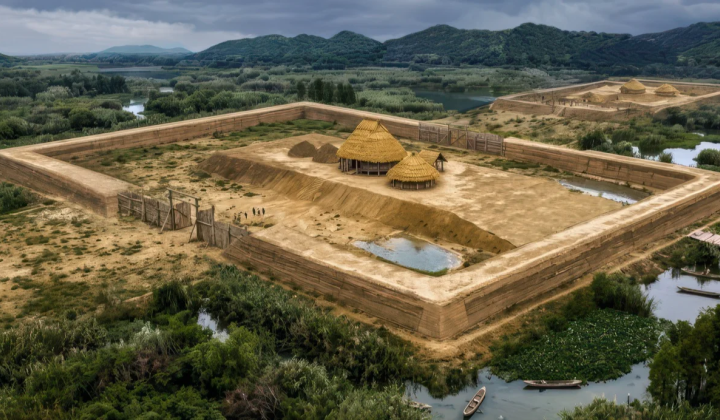
Revealing Ancient Architecture Adjacent to the Fanshan Necropolis
According to НВ — Техно: Researchers from the Zhejiang Provincial Institute of Cultural Relics and Archaeology in China have completed a digital reconstruction of three ancient buildings located close to the Fanshan necropolis. This burial site, dating back approximately 5,000 years, served as the royal cemetery for the elite of the ancient Liangzhu city. The reconstruction reveals that these tombs were part of a larger ceremonial complex, with the largest structure, known as F1, likely functioning as a hall for rituals honoring deceased rulers or noble ancestors.
Details and Significance of the Structures
To the south of the cemetery, archaeologists uncovered 120 postholes indicating wooden supports, which outline three buildings named F1, F2, and F3. The largest, F1, is oval-shaped, measuring 25.2 by 16 meters, covering roughly 316 square meters. This building may have stood up to 15 meters tall, featuring an elevated wooden floor, a surrounding gallery, and a substantial roof. It was connected by a corridor to a circular building of 105 square meters and a nearly square structure spanning 23 square meters.
These edifices are situated near some of the most prestigious graves, including tomb M12, where valuable Liangzhu jade artifacts were found. Previously, a fence measuring 180 by 140 meters was identified around the burial area. Radiocarbon dating places the eastern and southern walls of this enclosure at about 5,000 years old, emphasizing their ancient origin. Fanshan gained attention in 1986 when archaeologists discovered a jade cong-a square ritual object with a circular hole-and a ceremonial jade axe. The presence of jade items in wealthy tombs highlights their role as symbols of power and social rank.
'F1 served as a xiangdian-a hall dedicated to ceremonies remembering deceased rulers or esteemed ancestors,' explained Wang Ninyuan.
This digital reconstruction opens new avenues for understanding the social and cultural life of ancient Liangzhu, highlighting the central role of religious and ceremonial practices in the community.
Completing the digital modeling of these buildings near the Fanshan necropolis marks a significant advancement in studying ancient Chinese culture. This breakthrough could transform perspectives on the religious customs and hierarchical structure of Liangzhu’s elite, as previous research mostly concentrated on burial sites. The discovered structures suggest complex rituals were performed to honor the dead, offering insight into the traditions and beliefs of that era.
In light of these recent discoveries, it's intriguing to compare them with another significant find in the region. An ancient palace unearthed in Nanzuo has provided insights into 300 years of continuous use before its burial, further illustrating the complexity of ancient societal structures in China. This parallel highlights the rich archaeological heritage that continues to unfold in the area.

Read also