CERN Physicists Observe Rare B⁰ Meson Decay to Muons, Reinforcing the Standard Model

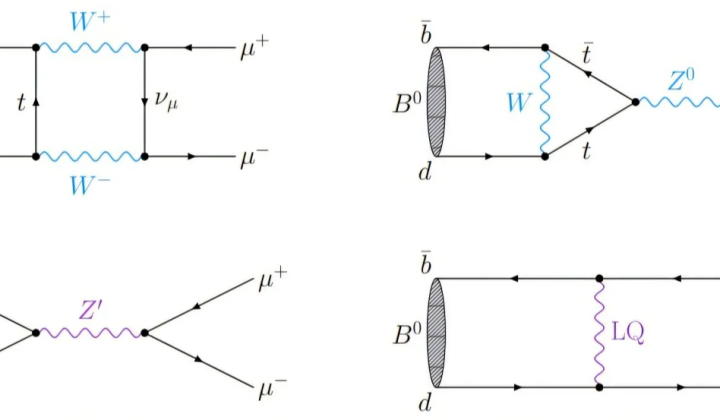
Breakthrough in Detecting B⁰ Meson Decay
According to НВ — Техно: On November 7, 2023, researchers at the European Organization for Nuclear Research (CERN) announced the experimental observation of an exceptionally rare decay of the B⁰ meson into a muon and an antimuon. This milestone serves as a crucial validation of the Standard Model, the prevailing theory describing fundamental particles and their interactions. The decay was detected using the LHCb detector at the Large Hadron Collider, originating from the annihilation of a bottom quark (b) and a down quark (d).
Predicted Probabilities and Experimental Findings
The Standard Model, formulated in 1984, predicts this decay to occur with a probability of approximately 1.03 in 10 billion B⁰ meson decays. For comparison, the analogous decay of the B⁰ₛ meson is even rarer, with a predicted rate of 3.66 in a billion; this latter decay has already been observed in previous experiments. Despite efforts spanning over four decades, evidence for the B⁰ meson decay was only recently obtained, with a statistical significance of 3.2 sigma.
Combining data from proton-proton collisions scheduled for 2024–2025 with earlier measurements, scientists have determined the B⁰ meson decay frequency to be about 1.14 per 10 billion events. The B⁰ₛ meson's decay has been measured with a precision of 3.25 per billion, and its effective lifetime is approximately 1.60 picoseconds. These results align closely with Standard Model predictions and show no indication of physics beyond the current theoretical framework.
Future runs of the collider aim to refine the decay rate measurements and deepen the understanding of the underlying decay mechanisms. Detailed Feynman diagrams illustrating the B⁰ → µ⁺µ⁻ decay are expected to be published on arXiv by 2026. This research represents a significant advance in particle physics, enhancing our knowledge of elementary particles and their behavior.
The findings have important implications for the ongoing development of particle physics theory, as they reinforce the Standard Model-the cornerstone of modern physics.
Discoveries of such rare decays provide valuable insights into the fundamental processes governing particle interactions and could eventually reveal new physics phenomena not yet explored. Continued high-precision experiments at the Large Hadron Collider hold the potential to uncover groundbreaking developments in the field.
The recent findings on B⁰ meson decay not only reinforce the Standard Model but also raise intriguing questions about potential discrepancies in b-quark behaviors. For instance, the CMS and LHCb collaborations have reported consistent deviations in b-quark decays, suggesting that further investigations could unveil new physics beyond the established theories.

Read also