Physicists Reveal New Particle Behaviors by Simulating Quark-Gluon Plasma from the Universe’s Earliest Moments

Breakthrough Insights into the Universe’s Birth through Quark-Gluon Plasma Studies
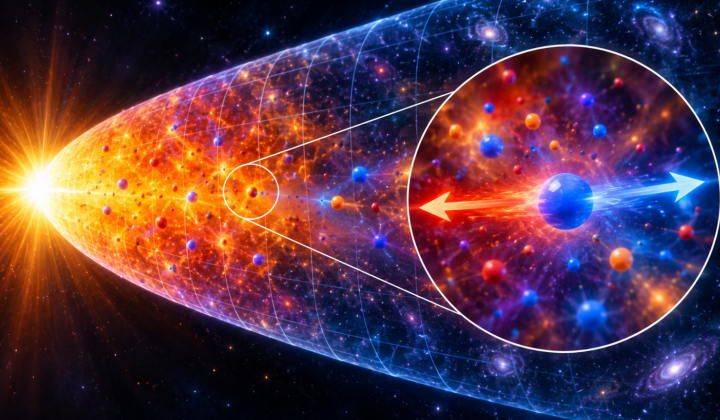
According to Radiotrek — Світ: Scientists are recreating the extreme conditions that existed just after the Big Bang by generating quark-gluon plasma, a state of matter that dominated the early universe. In those initial moments, temperatures soared to trillions of degrees, and particles within this plasma traveled at nearly the speed of light. As the universe cooled, quarks and gluons combined to form protons and neutrons, laying the groundwork for the matter we observe today.
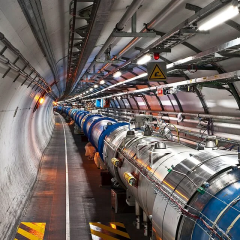
To better understand this primordial phase, researchers employ powerful particle accelerators that replicate the intense environment of the quark-gluon plasma. Their latest findings indicate that heavy quarks experience predominantly strong decelerating forces rather than accelerating ones. This behavior is consistent across different plasma types, highlighting crucial aspects of the universe’s structural evolution following the Big Bang.
Investigating Heavy Quark Dynamics within the Plasma
Physicists focus on tracking the motion of heavy quarks as they interact with the plasma. Intriguingly, their experiments demonstrate that Albert Einstein’s 1905 Brownian motion model falls short when describing particle behavior at velocities approaching light speed. According to Einstein’s theory, particles receive random impacts from their surroundings, with strong kicks being rare and roughly equal in all directions.
However, the quark-gluon plasma behaves more like a dense fluid than a gas, challenging traditional assumptions. Researchers plan to validate their updated theoretical models against empirical data from particle accelerators, advancing our comprehension of conditions prevalent in the universe’s infancy. These efforts open promising avenues for unraveling the mysteries of cosmic origins.
Beyond shedding light on the early universe, these discoveries could transform our understanding of fundamental physics by revealing how matter behaves under extreme conditions. Continued research is expected to provide deeper insights into the fundamental forces shaping the cosmos and may even inspire new theoretical frameworks and technological innovations based on this cutting-edge knowledge.
Understanding the behavior of quark-gluon plasma is crucial for unraveling the mysteries of the universe's formation. In this context, recent research delves into why matter prevailed over antimatter after the Big Bang, shedding light on fundamental processes that shaped the cosmos. These insights could provide a more comprehensive picture of the early universe and the forces that influenced its evolution.

Read also