Comprehensive 2027 HR Planner: Free Excel Template for Managing Essential HR Tasks

2027 HR Annual Planner
According to AIHR: Designed to help organizations streamline their human resources management, the 2027 HR annual planner enables effective scheduling of critical HR initiatives, deadlines, and responsibilities across each quarter. This tool aligns HR activities with business goals, workforce planning, talent development, employee experience, and compliance requirements. To facilitate practical use, a customizable Excel template is offered free of charge, adaptable to the unique needs of any organization.
The planner is structured around four main focus areas:
- business and workforce planning;
- talent development;
- employee experience;
- regulatory compliance and administrative tasks.
Additionally, it incorporates U.S. federal holidays, reporting deadlines, and monthly and quarterly HR milestones, with adjustments for dates falling on weekends. Regular quarterly reviews of the planner are advised to keep pace with shifting business priorities and legislative changes.
Quarterly Highlights and Important Dates
The first quarter (January–March) centers on setting HR objectives, closing tax obligations from the previous year, and updating employee guidelines. Key dates in January 2027 include: January 1 – New Year's Day (federal holiday), January 18 – Martin Luther King Jr. Day (federal holiday), and January 28 – Data Privacy Day. February's notable deadlines are February 1 for submitting W-2, 1099-NEC, Form 940, and Q4 Form 941, alongside Presidents' Day on February 15 (federal holiday). March deadlines include March 1 for paper submission of ACA Forms 1094-C and 1095-C, and March 31 for their electronic filing.
In the second quarter (April–June), emphasis is placed on preparing managers for mid-year reviews, revising recruitment strategies, and analyzing employee engagement and turnover data. April 2027 features Stress Awareness Month (April 1–30), Administrative Professionals Day on April 21, Earth Day and Take Your Child to Work Day on April 22. May continues Mental Health Awareness Month and Asian American Heritage Month, concluding with Memorial Day on May 31 (federal holiday). June includes Pride Month and National Safety Month (June 1–30), with Juneteenth observed on June 18 (federal holiday).
The third quarter (July–September) focuses on finalizing benefits updates, preparing for open enrollment, planning compensation, and initiating Q4 hiring. July 2027 highlights include July 1 wage increases in several states and cities, and the July 5 observance of Independence Day (federal holiday). August deadlines include August 2 for submission of Form 5500, Q2 Form 941, and PCORI fees, as well as Women’s Equality Day on August 26. September features Labor Day on September 6 (federal holiday), National Payroll Week from September 6–10, World Suicide Prevention Day on September 10, Hispanic/Latino Heritage Month from September 15 to October 15, and the September 30 deadline for VETS-4212 reporting for federal contractors.
The fourth quarter (October–December) includes open enrollment, final annual performance reviews, compensation decisions, and HR planning for the upcoming year. October 2027 observes Disability Employment Awareness Month (October 1–31), World Mental Health Day on October 10, and Columbus Day/Indigenous Peoples' Day on October 11 (federal holiday). November’s important dates are the November 1 Q3 Form 941 deadline, Veterans Day on November 11 (federal holiday), and Thanksgiving on November 25 (federal holiday). December activities begin with W-2 data validation early in the month, followed by Christmas Eve on December 24 (observed federal holiday) and New Year's Eve on December 31 (observed federal holiday).
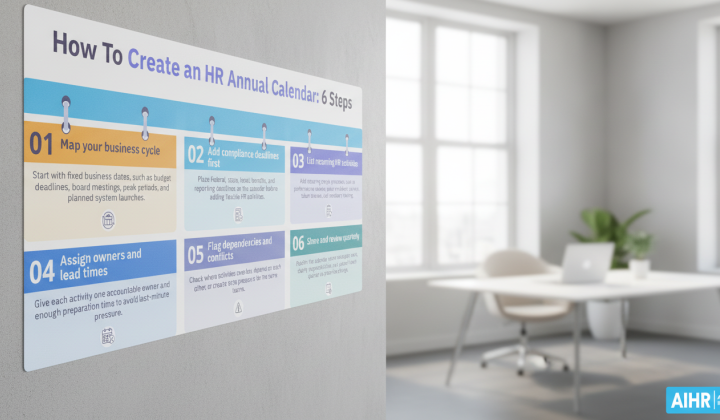
Key steps in creating an HR annual planner include:
- aligning with the business cycle;
- incorporating compliance deadlines;
- listing recurring HR activities by category;
- assigning responsibilities and preparation timelines;
- identifying dependencies and potential conflicts;
- distributing the planner and conducting quarterly updates.
Typical preparation timelines are: open enrollment – 90 to 120 days, compensation cycles – 8 to 12 weeks, engagement surveys – 6 to 8 weeks, and performance evaluations – 4 to 6 weeks. According to Gartner, 47% of managers feel expectations have increased compared to last year, while Mercer forecasts an 8.2% rise in overall healthcare insurance costs in 2027.
For organizations facing growing demands on HR functions and escalating healthcare expenses, the 2027 HR annual planner serves as an essential resource. It supports structured planning, ensures timely compliance, minimizes risks, and boosts workforce management effectiveness through proactive scheduling.
As organizations prepare for the future, understanding the role of technology in HR processes becomes increasingly vital. The integration of AI in business operations, particularly in human resources, is projected to evolve significantly by 2027. To explore how artificial intelligence will reshape workplace dynamics and its potential benefits, read more about this trend in our detailed analysis.

Read also