How HR Certification Without Experience Can Unlock Career Advancement and New Opportunities

HR Management and Certification
According to AIHR: In today’s professional landscape, earning certification in Human Resources (HR) has become a crucial stepping stone for career advancement. This article explores the possibility of obtaining HR certification without prior work experience, detailing various certification programs, their prerequisites, costs, duration, and a step-by-step approach to acquiring credentials and practical HR skills.
According to Payscale, 82% of HR assistants surveyed received promotions within the last five years, highlighting the role certification plays in boosting career prospects. Many HR leaders agree that holding recognized HR certifications significantly improves chances for advancement. In the United States, programs like HRCI’s aPHR and SHRM’s SHRM-CP do not require previous HR experience. Similarly, AIHR Certificate Programs allow entry without experience or higher education qualifications.
Certification Requirements and Costs
Other certifications have specific experience requirements: HRCI’s PHR demands one year of work experience with a master’s degree, two years with a bachelor’s, or four years without a degree. The SPHR certification requires four years with a master’s, five with a bachelor’s, or seven without a degree. SHRM-SCP calls for at least three years in a strategic HR role or three years plus a SHRM-CP certification.
The cost of HR certifications varies:
- HRCI aPHR costs $400, valid for three years, with a requirement of 45 hours for recertification.
- SHRM-CP is priced at $399 for SHRM members and $499 for non-members, requiring 60 Professional Development Credits (PDCs) every three years.
- HRCI aPHRi, targeted at international candidates, has similar fees and requirements.
- The CIPD Level 3 Foundation Certificate features no formal entry criteria, includes four written assignments, spans 8 to 12 months, and costs between £1300 and £2300 plus a £118 membership fee.
- PayrollOrg’s FPC certification requires no experience, costs $359 for members and $459 for non-members, includes a 150-question, three-hour exam, is valid for three years, and mandates 60 hours of recertification.
- AIHR’s Certificate Programs cost $1125 per course or $1850 for one year of unlimited access to 17+ programs and 85+ courses, with each program requiring 25 to 45 hours of study.
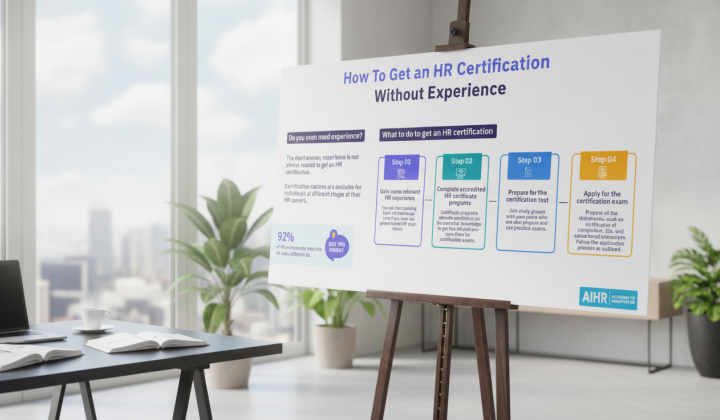
For individuals aiming to obtain HR certification without prior experience, it’s advisable to first develop foundational HR competencies, prepare thoroughly for the certification exam, complete application procedures, and maintain ongoing learning. Achieving certification enhances employability, supports promotions, increases earning potential, fosters career growth, and connects professionals to valuable industry networks.
Maintaining certification requires continuous education through seminars, webinars, and courses. Notably, AIHR is recognized by SHRM for awarding PDC credits toward SHRM-CP and SHRM-SCP recertification, and its courses are accepted by HRCI, HRPA, CPHR, ATD, and CIPD for recertification purposes. This underscores the accessibility of HR certification for newcomers eager to build a career in the field.
In summary, pursuing HR certification without prior work experience offers a viable path for individuals seeking to enter and excel in human resource management. Given the high promotion rates among certified HR assistants, these programs represent a valuable investment for professionals aspiring to succeed. Beyond opening doors to new roles, certification cultivates essential skills for effective people management and HR operations.
While obtaining HR certification can significantly enhance your career prospects, it's essential to consider the value of different certification programs. For instance, the worth of SHRM certification has been debated, with many professionals questioning whether the investment aligns with the potential benefits. Understanding these nuances can help you make a more informed decision about your professional development.

Read also