Schiebel Successfully Launches Smaller Drone Mid-Flight from CAMCOPTER S-100 UAV

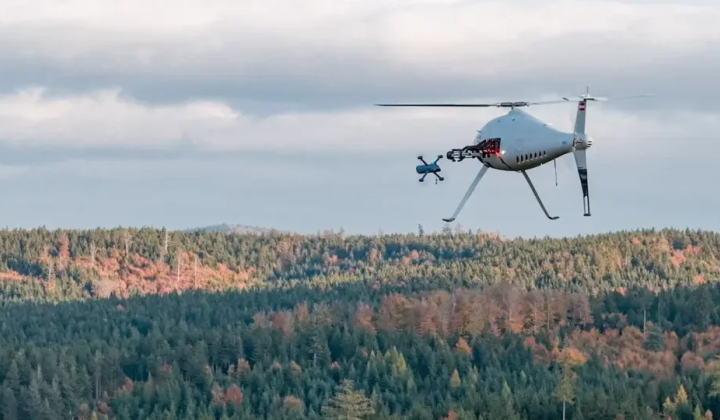
CAMCOPTER S-100 Flight Demonstration
According to НВ — Техно: On November 18, Schiebel achieved a significant milestone by successfully deploying a smaller unmanned aircraft from its CAMCOPTER S-100 UAV while in flight. This demonstration validated the concept of using the CAMCOPTER S-100 as an airborne platform capable of launching, controlling, and relaying video from smaller drones. The trials took place in Austria with participation from OSIRIS Poland, during which the CAMCOPTER S-100 released an inert OSIRIS HSCD-1 drone equipped with a camera. Throughout the flight, the smaller drone maintained communication via the CAMCOPTER S-100.
CAMCOPTER S-100 Specifications
The CAMCOPTER S-100 weighs 114 kg and can carry payloads up to 50 kg, excluding fuel weight. Its maximum takeoff weight is approximately 200 kg. Thanks to its rotorcraft design, it can take off and land vertically without the need for a runway. With a cruising speed above 102 km/h and a top speed reaching 185 km/h, the platform was originally developed in the early 2000s and has since been deployed across military and civilian missions, including:
- maritime surveillance
- intelligence gathering
- border security
- disaster response
Hans Georg Schiebel, a company representative, commented:
"This proof of concept highlights the impressive potential of combining the mature and reliable CAMCOPTER with smaller specialized UAVs." - Hans Georg Schiebel
Alongside these UAV advancements, Airbus recently unveiled plans for an unmanned version of its H145 helicopter, named the U145, with its maiden flight anticipated by the end of 2024. Mathieu Louvo, representing Airbus, noted:
"With the U145, we offer customers an autonomous UAV variant of the H145 that merges the trusted airframe, power, and payload capacity of the H145 with the autonomy of an unmanned system." - Mathieu Louvo
Defense applications for the CAMCOPTER S-100 concept also extend to counter-UAS (C-UAS) technologies. The CAMCOPTER S-100 continues to prove its adaptability and effectiveness in modern operational environments, opening new avenues for both military and civilian uses.
This successful demonstration underscores the critical role of innovation in unmanned systems, which can significantly enhance the capabilities and safety of military and civilian missions alike. As drones become increasingly integral to various sectors, developments like these promise to improve surveillance, threat response, and operational efficiency. Meanwhile, initiatives such as Airbus’s U145 highlight a broader trend toward integrating robotic technologies into conventional aviation platforms, potentially transforming how aerial tasks are accomplished in the near future.
In addition to the advancements demonstrated by Schiebel, the evolution of drone technology continues to gain momentum, as evidenced by BAE Systems' recent introduction of a passive radar system designed to detect both drones and traditional aircraft. This innovative approach could significantly enhance aerial surveillance capabilities, complementing the operational strengths of platforms like the CAMCOPTER S-100. For more insights on this cutting-edge technology, visit BAE Systems' Ghost Radar.

Read also