International Astronomers Confirm Neptune Trojan Asteroid Population for the First Time

Discovery of Trojan Asteroids in Neptune’s Wake
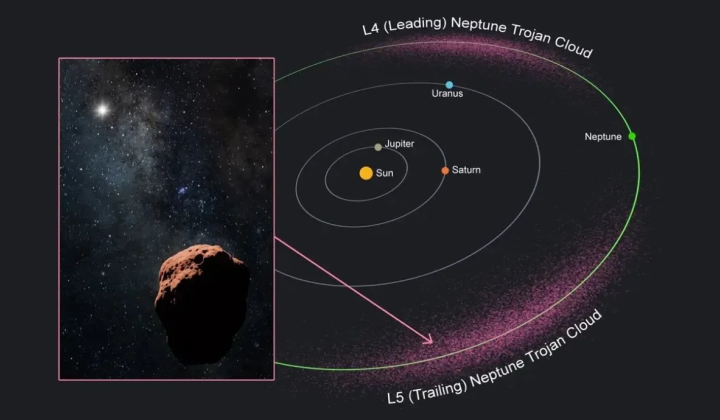
According to НВ — Техно: An international team of astronomers has, for the first time, confirmed a population of Trojan asteroids trailing Neptune, thanks to observations from the Vera Rubin Observatory located in the Chilean Andes. Their findings were published in The Astrophysical Journal Letters. These Neptune Trojans had remained hidden for years due to the dense starfield of the Milky Way’s center, where the glare from millions of stars made detecting them extremely challenging.
During this study, researchers identified two new Trojan asteroids and one additional candidate. Utilizing the Vera Rubin Observatory’s cutting-edge optics and the world’s largest digital camera, they captured images through various optical filters. These observations revealed surface characteristics closely matching those of known Neptune Trojans. Dr. Meg Schwamb commented on the breakthrough:
“This cloud of asteroids is finally emerging from the star-crowded region of the sky. Thanks to the Vera Rubin Observatory’s unique optics, we have doubled the number of known objects in this population.”
The Origins and Importance of Trojan Asteroids
Trojan asteroids are ancient rocky and icy bodies that share a planet’s orbit, residing in stable gravitational zones. First discovered near Jupiter in 1906, similar objects have since been found orbiting alongside Saturn and Uranus. Uncovering new Trojans in Neptune’s trail opens fresh avenues for studying these intriguing remnants of the early solar system.
This breakthrough highlights the vital role of advanced astronomical technology in probing the distant reaches of space and enhances our comprehension of the formation and evolution of the Solar System. With these new insights, astronomers can better investigate the dynamics of Trojan asteroids and their role within the broader context of planetary system development.
The discovery of Trojan asteroids around Neptune not only enriches our understanding of the outer solar system but also parallels recent advancements in astronomical observations. For instance, the recent findings from the Hubble and James Webb telescopes have unveiled 27 new icy bodies at the edge of our solar system, further demonstrating the capabilities of modern technology in exploring celestial phenomena.

Read also