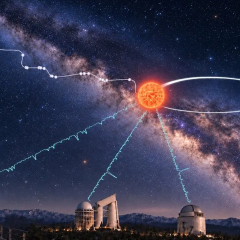
Fast-Spinning Star, Not Black Hole, Identified in NGC 1850 BH1 Within the Large Magellanic Cloud

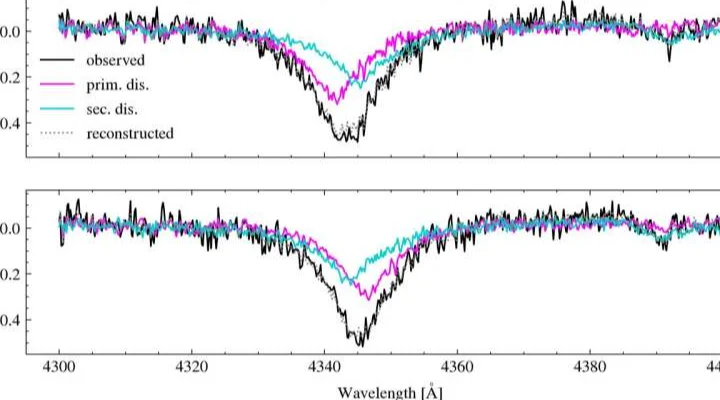
Astronomers Correct Misidentification: A Rapidly Rotating Star Mistaken for a Black Hole
According to НВ — Техно: Researchers have revealed that the object previously classified as a black hole in the NGC 1850 BH1 system is, in fact, a swiftly rotating star. This system is part of the star cluster NGC 1850, located in the Large Magellanic Cloud, a nearby satellite galaxy of the Milky Way. Detailed spectral analysis uncovered two luminous sources instead of the expected black hole and star combination.
Earlier assumptions held that the system contained a typical star with about 5 solar masses orbiting an 11-solar-mass black hole. The absence of significant X-ray emissions from the supposed black hole cast doubt on its presence. A team led by Rhys C. Seyburgh from Liverpool John Moores University applied spectral disentangling techniques using data from the FLAMES spectrograph on the Very Large Telescope (VLT) to re-examine the system.
Key Findings from the Study
The investigation identified two distinct bright components:
- A cool, bloated star weighing approximately 1.7 times the mass of the Sun;
- A hot, massive companion star with about 5.2 solar masses, rotating at roughly 280 km/s.
These stars likely evolved through past mass transfer between them, with the motion of the visible star mimicking the gravitational signature previously attributed to a black hole. This misinterpretation led to the earlier incorrect conclusion about a black hole’s existence in the system.
Despite these insights, the dense stellar environment and faintness of the objects introduce uncertainties that require further clarification. The research was published on the arXiv preprint server on November 14, 2023. This discovery highlights the necessity for meticulous data analysis and cautious interpretation when studying complex astronomical systems.
This finding underscores the complexity of cosmic systems and the critical importance of rigorous data verification in scientific research.
Ongoing studies of stellar and black hole interactions continue to refine our understanding of galaxy evolution and star formation. Cases like NGC 1850 BH1 serve as important reminders that observational data must be carefully scrutinized to avoid errors that could misguide scientific knowledge.
This recent finding underscores the complexities of astronomical observations, particularly when misidentifications can occur in dense star systems. In a related study, researchers have explored a supermassive black hole duo at the core of Mrk 501, which orbits every 121 days and is on a path towards a rare collision. To understand the dynamics of such systems and the implications for black hole research, read more about this fascinating discovery here.

Read also