Hungarian Opposition Leader Demands President's Resignation Following Palace Meeting

Hungary's President Urged to Step Down
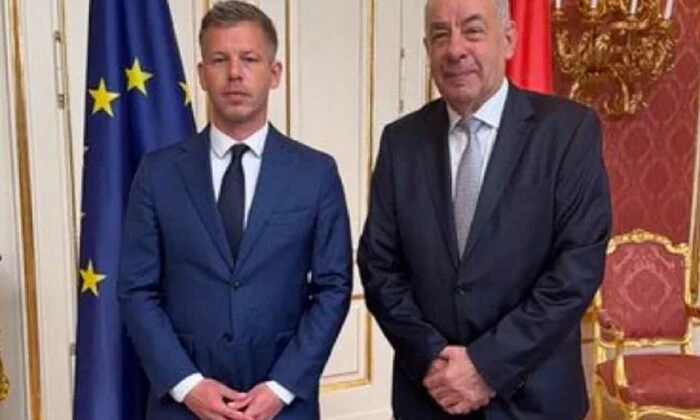
According to Главком: Following an official meeting with Hungarian President Tamás Sulyok on April 15 at the presidential residence, the Sándor Palace, Tisza Party leader Péter Magyar publicly called for the president's resignation. Magyar stated that Sulyok is unfit to serve as the guardian of the rule of law or as a moral example for the nation. This demand highlights the deepening political divisions within Hungary's governing coalition.
“Tamás Sulyok is unworthy of embodying the unity of the Hungarian nation. He is unworthy of being the guardian of the rule of law. He is unworthy of being a moral benchmark and a role model,” Magyar stated.
Magyar insisted the president should leave his post immediately after a new government is formed. During his visit, Magyar also noted seeing Prime Minister Viktor Orbán reading a newspaper on a nearby balcony, a detail that further underscores the tense political climate in Budapest.
Broader Political Stakes and International Implications
Beyond domestic politics, Magyar expressed Budapest's readiness to unblock a €90 billion EU loan for Ukraine, contingent upon the restoration of oil supplies via the 'Friendship' pipeline. This stance directly links Hungary's internal political dynamics to critical European security and aid issues.
“Tamás Sulyok must leave his position immediately after the formation of a new government,” the Tisza Party leader emphasized.
These statements underscore the complex situation in Hungarian politics and its potential consequences for international relations, particularly regarding support for Ukraine. The call for President Sulyok's resignation by Péter Magyar signals rising political tension in Hungary, where questions about the rule of law and the moral authority of leaders are becoming increasingly prominent. Simultaneously, Hungary's conditional offer to unblock Ukrainian aid highlights how domestic politics can directly influence key international economic support during a volatile geopolitical period in Eastern Europe.
The ongoing political turmoil in Hungary raises significant questions about leadership and accountability. As the situation evolves, the implications of these demands are becoming clearer, particularly in relation to the recent election outcomes. For a deeper understanding of how these developments affect Hungary's political landscape, read more about the election victor's stance on President Sulyok's future.

Read also