Putin Denies Russia’s Role in the War at Valdai Forum, Raises Nuclear Threats and Highlights Kaliningrad Issue

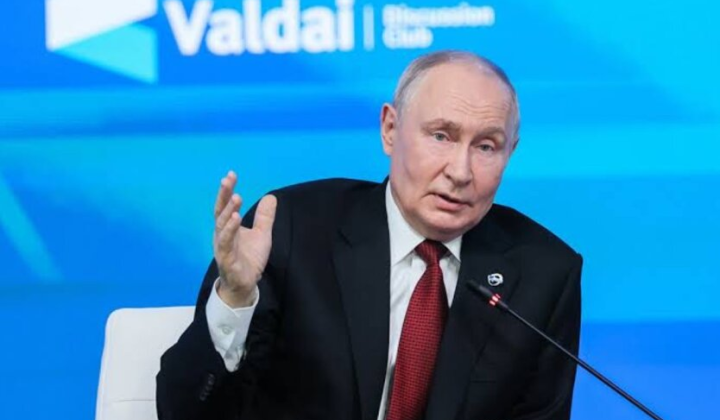
Vladimir Putin’s Speech at the Valdai Discussion Club
According to ХВИЛЯ: On October 1, 2026, Vladimir Putin addressed the plenary session of the Valdai Discussion Club held in Moscow, where he presented key Kremlin narratives about the ongoing war in Ukraine. During his speech, Putin rejected any Russian responsibility for the conflict and attacks on civilian infrastructure in Ukraine, while also invoking nuclear rhetoric. He brought up the strategic significance of the Kaliningrad region and outlined his vision for a new global order. For security reasons, this was the first time the event took place in Moscow.
Russia consistently cites perceived NATO security threats to justify its military actions. Putin pointed out that Russian security guarantees were announced in December 2021, roughly two months before the full-scale invasion of Ukraine began. The Kremlin also leverages concerns about a potential blockade of Kaliningrad to intensify its military messaging, portraying the region as a tool for information pressure.
Nuclear Messaging and Territorial Concessions
Russia’s nuclear rhetoric compares its arsenal to those of the United Kingdom and France, deliberately overlooking the broader NATO nuclear capability, especially that of the United States. Putin’s denial of Russian accountability for the war has drawn widespread international condemnation. European Commissioner for Defense, Andrus Ansip, emphasized that
“the focus must also remain on the political decision by Russia, with Putin at its core, to initiate and sustain aggression.”
Putin also raised the prospect of Ukraine making territorial concessions as part of any potential resolution to the conflict. The narrative of 'inevitable' territorial losses is employed to exert psychological pressure on Ukraine and the global community. This messaging lays the groundwork for possible future escalations and justifications for additional actions. Although Russia’s public threats do not confirm a plan to attack NATO, they keep the alliance’s unity under scrutiny.
Moreover, Russia challenges Ukraine’s political sovereignty, reflecting a broader foreign policy stance. The concept of a 'new world order' has been a consistent element of Russian rhetoric since at least 2008, signaling the Kremlin’s ambition to reshape global geopolitical structures. Since assuming the presidency in 2000, Putin has frequently invoked historical precedents, including NATO’s 1999 intervention in Yugoslavia, to justify Russia’s international conduct.
The situation in Ukraine remains highly volatile, with Russia’s actions raising serious concerns worldwide. Moscow’s positions on the war and regional security, along with threats of escalation, continue to be central topics in international discussions.
Putin’s appearance at the Valdai Club highlights the persistent tensions between Russia and the West, as well as the complex domestic and global dimensions of the Ukrainian conflict. His references to nuclear weapons and the potential Kaliningrad blockade signal risks of escalating threats that could destabilize European security. The international community’s response to these developments will be closely watched, as the conflict in Ukraine continues to shape the geopolitical landscape of the region.

Read also