Discovery of a Deep-Sea Glass Salp in Monterey Bay Reveals Twin Births and Gender-Shifting Clones

A Newly Identified Transparent Salp Species
According to НВ — Техно: Dwelling in perpetual darkness and giving birth to twins, scientists have for the first time documented a remarkable transparent creature from the ocean’s depths.
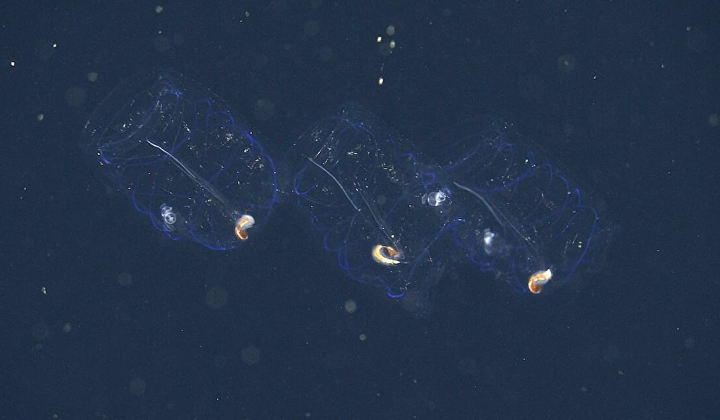
In the deep waters of Monterey Bay, researchers have identified a new transparent salp species named Vitreosalpa gemini. This organism inhabits depths ranging from 280 to 2200 meters and exhibits extraordinary reproductive traits, including the birth of twin embryos and sequential sex changes among its clones. Marine biologist Larry Madin from the Woods Hole Oceanographic Institution published a comprehensive description of this species in the journal Marine Biodiversity.
The unusual glass-like salp was first observed over two decades ago in Monterey Bay’s deep waters. Vitreosalpa gemini is the first known salp species to live exclusively in the deep sea. Salps are gelatinous marine animals closely related to vertebrates, including humans. Unlike most of the 50 known salp species that typically inhabit surface waters, this transparent salp thrives in the twilight and midnight zones of the ocean, where sunlight never reaches.
Distinctive Biological Features of the Glass Salp
This species filters organic debris and single-celled organisms through an internal mucous mesh. Its watery tissues and slower metabolism set it apart from surface-dwelling relatives. Individual salps form long chains containing dozens of genetically identical clones. In these colonies, the glass salp can give birth to twin embryos, while its clones undergo sequential sex changes-initially producing eggs before transforming into males.
Larry Madin: 'Every time we venture into the deep ocean, we are reminded of how little we understand about the planet’s largest habitat and the creatures that have thrived there for millions of years.'
This discovery highlights salps’ crucial role in the ocean’s carbon cycle, as they efficiently transport carbon from surface waters down to the deep seafloor.
The identification of Vitreosalpa gemini marks a significant advancement in our knowledge of deep-sea biodiversity. Given their vital function in carbon cycling, studying these organisms may offer important insights for ecological research and ocean health monitoring. Furthermore, exploring such enigmatic species underscores the urgent need to investigate poorly understood marine ecosystems, which likely harbor essential ecological processes yet to be uncovered.

Read also