Precise Measurement of Helium from the Universe’s First Five Minutes Achieved by Scientists

Tracing Helium from the Universe’s Infancy
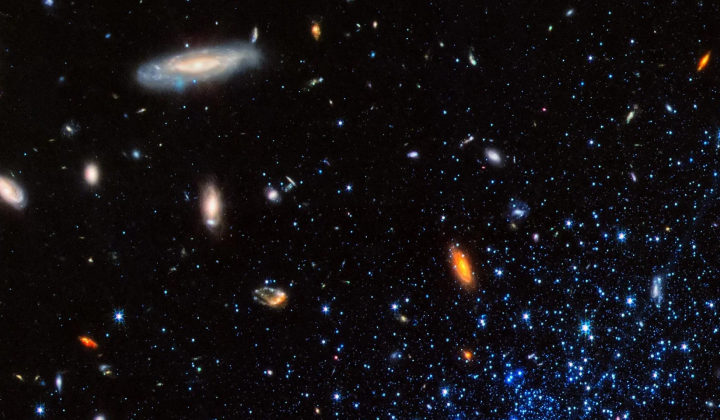
According to НВ — Техно: An international team of researchers has successfully measured the amount of helium produced within the initial five minutes after the Universe’s formation, reaching an unprecedented accuracy of 0.5%. Their study focused on 15 small, extremely distant galaxies, observed using the Large Binocular Telescope. The findings were published across five articles in the journal The Astrophysical Journal.
The team dedicated 130 hours to observation, examining over 10 helium spectral lines alongside 15 hydrogen lines. These galaxies have experienced minimal chemical evolution over time, making them ideal for studying primordial elements. This research has reduced measurement uncertainties by a factor of three compared to previous estimates, providing a more precise understanding of the Universe's original helium content.
Techniques and Implications of the Study
The scientists employed MODS spectrographs developed at Ohio State University for their analysis. Their measurements not only helped determine the number of neutrino families present during the early Universe but also offered critical tests for cosmological theories, including the Big Bang model. As team member Evan Skillman explained:
“The amount of primordial helium is directly linked to conditions that existed during the Universe’s first five minutes post-Big Bang. More accurate measurements allow us to rigorously test the Standard Model of physics - the framework describing known elementary particles and their interactions.”
Researchers from universities across the United States, the National Autonomous University of Mexico, and the Canadian TRIUMF research center contributed to this work. Understanding helium’s abundance at this early stage is a vital step toward unraveling cosmic processes and the evolution of the Universe, which began expanding about 13.8 billion years ago.
This breakthrough highlights the critical role of precision in astronomy and physics, as such data deepen our comprehension of the fundamental mechanisms shaping the cosmos. The results could have far-reaching consequences for future investigations, potentially confirming or challenging existing theories about elementary particles and their interactions. Consequently, this achievement marks a significant advance in modern physics and astronomy.
In addition to the recent findings on primordial helium, researchers are also exploring the characteristics of massive, metal-poor stars in nearby dwarf galaxies. These stars, which provide valuable insights into the early Universe's chemical composition, are being studied through the TEMPOS project. Understanding the evolution of such stars complements the ongoing research into the Universe's formative moments and sheds light on the conditions that shaped its earliest structures.

Read also