Magnetic Field Secrets Revealed by Winds on Hot Jupiters

Exploring Hot Jupiters
According to НВ — Техно: A fascinating link between wind speeds and magnetic fields on hot Jupiters has been uncovered by researchers. Observations using the MAROON-X instrument on the Gemini North telescope and the ESPRESSO spectrograph at the European Southern Observatory's Very Large Telescope revealed that wind velocities on these exoplanets range from 2 to 7 km/s. The study also found an inverse relationship between a planet's temperature and its wind speed: the hotter the exoplanet, the slower its atmosphere moves. This discovery sheds light on the hidden magnetic environments of these distant worlds.
Hot Jupiters orbit extremely close to their host stars, leading to their scorching temperatures. Some complete a full orbit in less than a day. This proximity causes one side of the planet to be permanently facing the star, subjected to intense heat, while the other side remains in perpetual darkness.
Lead researcher Julia Seidel from the Côte d'Azur Observatory in France comments: 'This finding opens up new avenues for exoplanet research and, for the first time, allows us to compare the magnetic environments of other worlds.'
Astronomer Vivien Parmentier notes that the discovered relationship 'defies expectations, since hotter planets have more energy to drive faster winds.' She adds that 'there must be a mechanism slowing down atmospheric flows on the hottest objects.'
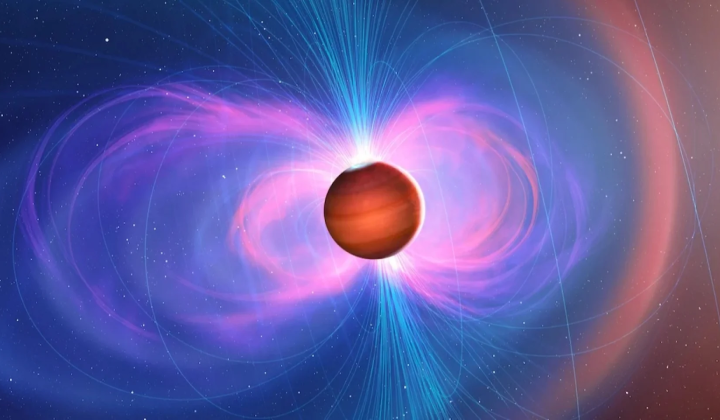
The estimated strength of magnetic fields on hot Jupiters is a few Gauss, roughly comparable to Jupiter's magnetic field in our own solar system. The fastest winds observed on Jupiter, the solar system's windiest planet, reach about 0.4 km/s-far slower than those on hot Jupiters. These new insights could advance the study of exoplanet atmospheres and their magnetic fields.
Future Research Prospects
The study of hot Jupiters opens new frontiers in astronomy, as detecting magnetic fields can help unravel the complex atmospheric processes on these planets. This, in turn, may reshape our understanding of how exoplanets form and evolve in various star systems. Exploring the atmospheres and magnetic fields of these exoplanets could be a crucial step in the search for life beyond Earth.
Understanding the magnetic fields of hot Jupiters can be further enriched by exploring the dramatic temperature contrasts on distant exoplanets, as revealed by the James Webb Telescope. These insights into day-night divides could provide additional context to the atmospheric dynamics and magnetic interactions observed in these intriguing worlds.

Read also