Over Half of Companies Lack a CEO Succession Plan – How to Avoid a Leadership Crisis

The Critical Role of Succession Planning and Its Challenges
According to AIHR: For any organization, ensuring continuity in key leadership roles is essential, and succession planning is the process that makes this possible. It involves identifying and developing top talent to prevent disruptions when executives leave or transition. Yet, recent research reveals that 53% of companies have no plan in place for an unexpected CEO departure, putting their stability at serious risk.
Only 34% of organizations consider their succession planning process highly effective. Meanwhile, 83% rely on mentoring and coaching to prepare potential successors, 72% offer formal training programs, and 70% use stretch assignments to build employee readiness for future challenges. These figures highlight the need for a systematic approach to developing leadership skills and management potential.
HR’s Central Role and Industry Best Practices
Experts emphasize that HR departments play a pivotal part in succession planning. They are responsible for identifying critical roles, evaluating possible successors, and designing development plans. As Jenna Fisher noted,
“organizations that fail to plan or build a strong talent pipeline risk losing the trust of stakeholders and investors due to uncertainty.”
This underscores the importance of a clear strategy for cultivating a leadership bench.
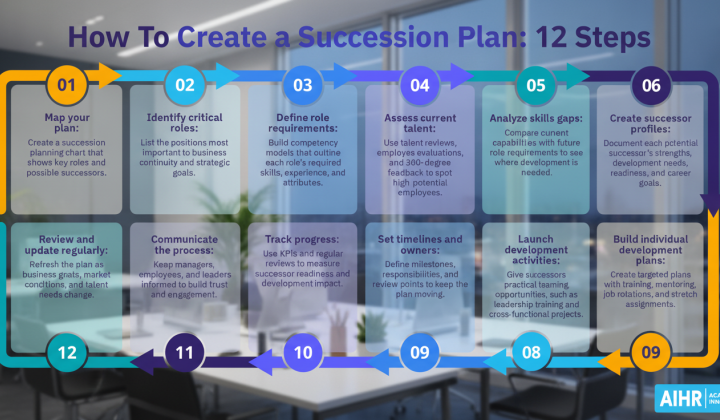
The succession planning process can be broken down into several key stages:
- Developing talent
- Identifying leadership potential
- Fostering leadership growth
- Making succession decisions
Best practices in this area include taking a long-term view, implementing structured development programs, integrating succession planning with overall talent management, and measuring outcomes. Tara Furiani noted that maintaining open lines of communication can also build trust and engagement, which are vital for a plan’s success.
Real-world examples of effective succession planning include the CEO transition at McCormick & Co in 2008, where Robert Lawless was succeeded by Alan Wilson following a five-year plan. Another case is the leadership change at Barneys New York, where Mark Lee stepped down as CEO in 2017, and Daniella Vitale-who had joined the company in 2010-took over. Additionally, Ajax Youth Academy enrolls children as young as seven, demonstrating the value of early talent development.
Tools such as Built, ClayHR, Cornerstone OnDemand, and TalentGuard can significantly streamline succession planning for HR teams. Free templates for mapping roles, readiness levels, development actions, and accountability are also available to support the process.
In summary, succession planning is a vital component of any talent management strategy. It helps organizations keep critical roles filled and reduces the risks tied to losing key employees.
Beyond ensuring leadership stability, succession planning also supports the growth of talented staff members. By studying current trends and applying proven practices, companies can greatly improve how they handle leadership transitions. In today’s rapidly changing business environment, organizations that take a proactive approach to succession planning are better positioned to stay competitive and resilient in the face of external challenges.
As organizations grapple with the importance of effective succession planning, it's crucial to recognize how strategic missteps in HR can further complicate leadership transitions. A recent report highlights that HR leaders are losing their influence in boardrooms due to inadequate strategies, which can exacerbate the risks associated with a lack of succession planning. Understanding these dynamics can help companies better navigate their leadership challenges.

Read also