HR Leaders Are Losing Boardroom Influence Due to Strategic Missteps

HR Leaders and Their Shrinking Boardroom Clout
According to AIHR: The issue of HR leaders’ influence in boardrooms is becoming increasingly urgent. While 70% of public companies report greater involvement of Chief Human Resources Officers (CHROs) in board discussions, a significant gap persists between mere attendance and actual impact. According to AIHR research, 41% of CHROs come from an HR Business Partner (HRBP) background, often lacking the skills needed to operate effectively at the board level. Persistent problems include an overload of data without sufficient insight, advocacy rather than advisory contributions, and reporting on the past instead of shaping the future.
It is worth noting that in 60% of companies, the CHRO is a regular participant in board meetings. However, Coqual research shows that executive presence-which accounts for 26% of what propels a leader to the next level-is critically important. Only 12% of HR leaders engage in workforce strategic planning beyond a three-year horizon. Furthermore, 42% of C-suite executives do not view HR as an equal strategic partner, and 36% consider HR only somewhat critical to business strategy.
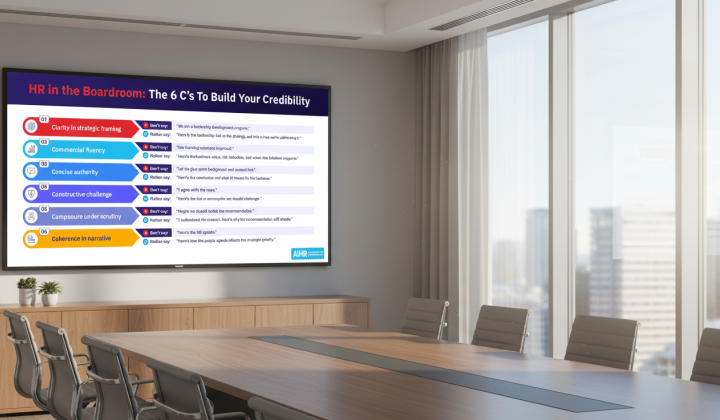
The 6C Model for Boosting Influence
Companies that take workforce effectiveness seriously are 4.2 times more likely to outperform competitors, achieving an average of 30% higher revenue growth. Over the past year, 64% of board members reported that talent management is a topic at every board meeting (PwC). The importance of developing executive presence is underscored by a quote from Candice Mitchell:
“98% of leaders must consciously develop executive presence.” - Candice Mitchell
To build trust and influence in boardrooms, the 6C model has been proposed, which includes:
- Clarity in strategic articulation (Clarity)
- Commercial fluency (Commercial fluency)
- Concise authority (Concise authority)
- Constructive challenge (Constructive challenge)
- Composure under pressure (Composure)
- Coherence of narrative (Coherence)
These factors are critical for HR leaders to overcome common pitfalls such as data overload, advocacy instead of advice, and reporting on the past.
Candice Mitchell also emphasizes the need for HR leaders to take an active stance:
“Waiting for an invitation, a title, or a seat at the table is not what matters. You must claim your place in that environment yourself.” - Candice Mitchell
The right messaging for the board includes positioning workforce risk as a business risk, culture as a performance variable, and competency gaps as strategic constraints.
HR leaders’ effectiveness in boardrooms requires not only participation but also active influence on company strategy. According to data, by 2024, the share of independent directors in the Russell 3000 with human capital qualifications rose from 10% to 25.5%, and in the S&P 500 to 38.3%. This reflects the growing importance of human capital in strategic corporate governance.
Given the above facts, HR leaders must do more than just attend board meetings; they need to actively shape business strategy. The rising number of independent directors with human capital expertise shows that companies recognize the importance of talent management and its impact on overall success. This highlights the need for HR leaders to develop skills and strategic thinking to overcome current challenges in this area.
As organizations strive to enhance their strategic capabilities, understanding the impact of AI on business processes becomes essential. Recent findings indicate that only a small fraction of companies have reached a mature level in AI implementation. This gap highlights the need for HR leaders to not only adapt but also to leverage technology effectively in their roles. For insights into the current state of AI maturity across industries and its implications for talent management, check out this article on AI adoption in businesses.

Read also