Skills Crisis Leaves 72% of Employers Struggling to Fill Positions

Major Hurdles in Talent Acquisition Today
According to AIHR: This article breaks down seven critical challenges in talent acquisition, covering the shift from reactive hiring to strategic workforce planning, the adoption of skills-based recruitment, and the integration of artificial intelligence. Currently, 72% of employers report difficulties in finding qualified workers, placing added pressure on HR departments. In the United States, entry-level job postings have dropped by 35% since 2023, signaling fewer opportunities for new professionals entering the labor market.
Over the past three years, one-third of the skills required for an average job have changed, with 30% of skills for a typical position shifting since 2022. This highlights the urgent need to adapt hiring strategies to evolving demands. Data shows that 66% of global job postings require a college degree, yet only 31% of the workforce holds one. This mismatch between employer expectations and candidate education levels creates additional obstacles in attracting talent.
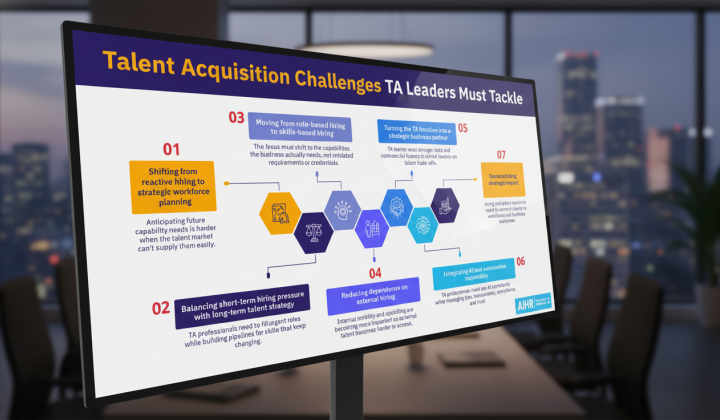
Lightcast research also indicates a shrinking working-age population in Europe, further complicating labor market dynamics. In response, HR professionals must move from reactive hiring to strategic workforce planning. The main challenges include:
- Shifting from reactive hiring to strategic workforce planning.
- Balancing short-term hiring pressures with long-term talent strategy.
- Moving from role-based hiring to skills-based hiring.
- Reducing reliance on external recruitment.
- Transforming talent acquisition into a strategic business partner.
- Integrating AI and automation responsibly.
- Demonstrating strategic impact.
To address these issues, strategic solutions are proposed, such as redefining the role of talent acquisition, building a skills-driven strategy, developing talent analytics, creating flexible talent access models, investing in upskilling TA teams, and leveraging AI to complement expertise. Measuring talent acquisition effectiveness through business impact is also becoming a key focus in this new landscape.
Adapting to a Changing Landscape
Today, organizations must consider four dimensions of AI proficiency: confident AI application, responsible AI practices, advocating for AI adoption, and integrating AI into workflows. To successfully tackle current labor market challenges, companies need to reshape their talent acquisition approaches accordingly.
The labor market is undergoing significant shifts that directly impact talent acquisition strategies. The growing gap between employer demands and the availability of skilled candidates underscores the importance of adapting HR strategies to new realities.
Successfully implementing skills-based hiring and integrating artificial intelligence can be key elements in overcoming these challenges.
As the job market evolves, understanding the factors influencing compensation becomes crucial for both employers and job seekers. Recent insights reveal that in today's hiring landscape, skills have become a more significant determinant of HR salaries than seniority. This trend underscores the importance of adapting to the shifting demands of the workforce, making it essential for organizations to align their hiring strategies with the current skills landscape.

Read also