Boston Dynamics Transforms Atlas Robot by Replacing Legs with Wheels to Test Speed and Heavy Loads

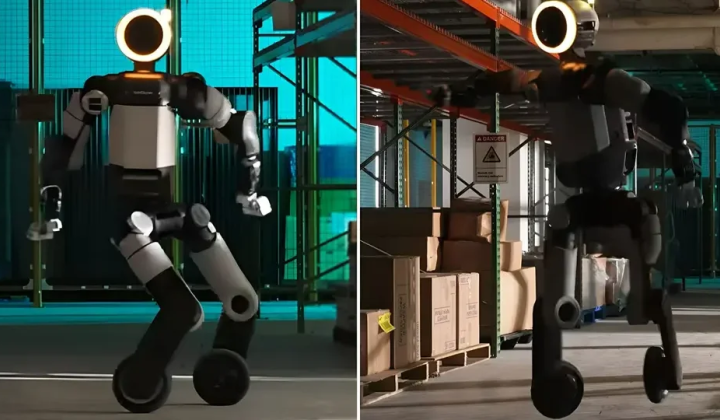
Atlas Robot Upgraded with Wheels Instead of Legs
According to НВ — Техно: On November 10 at 11:32, Boston Dynamics revealed a significant modification to their humanoid robot Atlas by swapping its legs for wheels. This experimental version is not intended for commercial use but serves as a research platform to explore high-speed locomotion and handling of heavy cargo. The wheels connect to the ankle actuators via a custom adapter, enabling testing of the robot’s motors and control systems based on machine learning algorithms.
The engineers kept the original hardware largely intact besides replacing the legs with wheels. Using reinforcement learning techniques, the wheeled Atlas refined its control systems through iterative testing. During physical trials, the team adjusted motor models to ensure simulations accurately reflected real-world performance. Impressively, the robot successfully executed a 360-degree jump on its first attempt, utilizing a trajectory tracking controller and rotating its lower body in preparation for takeoff.
Introducing Atlas’s New Four-Fingered Hand with Enhanced Dexterity
Earlier, Boston Dynamics unveiled a new four-fingered hand for Atlas featuring 13 degrees of freedom. Designed for manipulating objects and operating tools, this hand focuses on agility, strength, durability, tactile sensing, and the ability to train robotic behaviors within simulation environments. These upgrades highlight advancements in robotics and open new avenues for research in machine learning-driven control systems.
This development reflects ongoing innovations in robotics, where companies like Boston Dynamics push the boundaries by experimenting with novel designs and functionalities. The wheeled Atlas prototype demonstrates potential improvements in robot mobility and maneuverability, which could expand their applications across industries from manufacturing to scientific research. Furthermore, advancements in machine learning-based control methods hold promise for broader technological impact beyond robotics.
The advancements in robotics are not limited to Boston Dynamics. For instance, ROKAE has recently achieved a significant milestone by producing its 10,000th robotic arm, showcasing the growing capabilities of automation in various industries. This progress emphasizes the importance of innovative designs and functionalities in enhancing operational efficiency and versatility in robotics.

Read also