Inside Neptune's Tiny Moons, JWST Sees Remnants of Ancient Destroyed Worlds

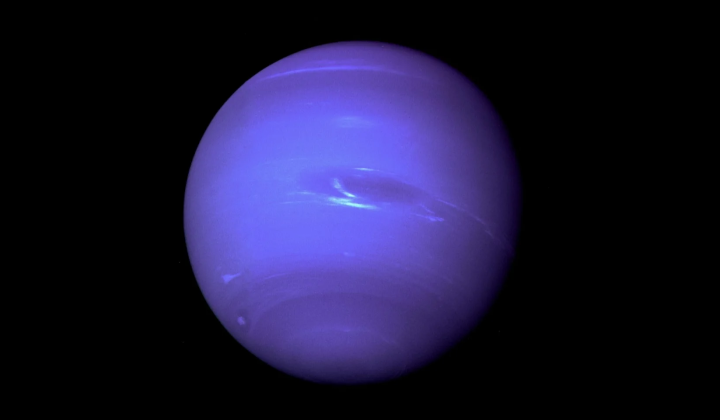
The Icy Giant's Puzzle
According to НВ — Техно: Neptune's small moons turn out to be pieces of ancient worlds that were smashed apart long ago.
August 14, 22:00
Using the James Webb Space Telescope, an international team from the California Institute of Technology has found that Neptune's inner moons and rings are built from material that once lay deep inside large, long-gone bodies. The team employed JWST's near-infrared spectrograph to study the chemical makeup of Larissa, Galatea, Proteus, and the planet's rings.
In the spectra of Larissa, Galatea, and the rings, they detected magnesium-rich phyllosilicates-minerals that can only form in the presence of liquid water and high temperatures. Such compounds had never before been observed in the outer solar system beyond Jupiter's orbit. The absence of water ice on the surfaces of the small moons adds further support to the new picture of their makeup.
What Happened to Neptune's Original Moons?
The findings point to a scenario in which Neptune once possessed an orderly system of large moons, comparable to what we see around Uranus today. That earlier arrangement was destroyed when Neptune gravitationally captured Triton, its current largest moon, which was born in a different region of the solar system. The inner moons we see now range from a few tens to a few hundred kilometers in diameter.
Published in Science Advances, the research has an impact on how scientists understand the history and evolution of Neptune's satellites. It also opens fresh avenues for investigating the composition and past of planets across our solar system. The paper's DOI is 10.1126/sciadv.aeb1437.
These discoveries could reshape our view of planetary-system formation, showing that even the remote outer solar system preserves traces of ancient worlds. By studying Neptune's moons, researchers can better understand how planets and their satellites came into being-and what conditions were like in the early solar system. JWST's infrared vision is especially suited for examining such faint, icy targets, making this kind of analysis possible.

Read also