Final signatory: how the Kremlin sells the meeting 'at the finish line' and bluffs deadlines

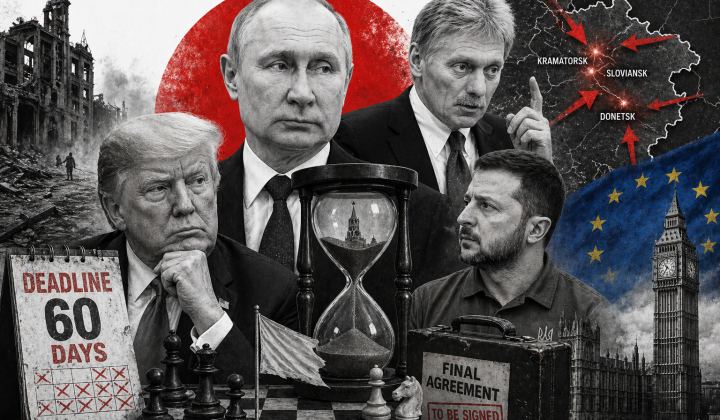
Dmitry Peskov officially confirmed that Vladimir Putin is ready for a personal meeting with Vladimir Zelensky. However, the Kremlin immediately set a tough filter: such a meeting is only possible at the stage of 'final agreement of agreements'. In fact, Moscow is refusing to engage in substantive dialogue, offering Kiev the role of a technical signatory in an already prepared scenario at lower levels.
'Meeting at the finish line' as a refusal of substantive negotiations
This is a diplomatic construct where the main thing is not the leaders' conversation, but the legalization of a previously laid out 'package'. The formula 'only after agreement' means: the Kremlin does not want to discuss the content publicly; it needs the final frame of the signature.
Two-month ultimatum and the mathematics of the front
This maneuver is the second part of the puzzle with the two-month ultimatum regarding Donbas. If we include the dry arithmetic of the general staffs, the picture is merciless to the Kremlin's plans:
- to occupy the remaining fortified areas of Donetsk region in 60 days, the pace must increase not by factors, but by dozens of times;
- currently, the advance is moving at an infantry pace - by 10-15 meters per day in key areas;
- any attempt to 'speed up' runs into a plateau: drones + EW + robotic platforms make deep breakthroughs extremely costly in terms of losses and time.
With such dynamics, the deadline for 'liberation' shifts to years, and the ultimatum becomes a media product rather than a military plan.
Who is this ultimatum for
This entire ultimatum is a product not for Syrskyi, but for Mar-a-Lago. Moscow transmits to Washington:
'Either you force Kiev to retreat now through diplomatic pressure, or we take everything by force.'
Trump in this scheme is the only potential 'emergency brake': only a harsh collapse of American logistics, communications, and supply of spare parts can turn bluff into reality. Without such leverage, the Kremlin has no physical power to 'press' the land within the stated deadlines.
'Anti-emergency brake': London and Brussels
However, the calculation of American isolation of Ukraine did not come true. While Moscow awaits Trump's reaction, London and Brussels have entered the game:
- British oversight in the General Staff;
- European tranches and packaging of support.
This is the 'anti-emergency brake': insurance against sudden default of American support. Therefore, Peskov's statement flies into emptiness: behind Kiev, there are already alternative contours of stability.
Conclusion
Putin is trying to convince the world of the inevitability of triumph before symbolic dates, but the figures of daily advances speak otherwise. Without decisive intervention from Trump, the Kremlin will either have to quietly 'forget' the deadlines or raise the stakes at the cost of internal destabilization.
Answer to the question
Trump likely understands that he is being used as an instrument of someone else's bluff - but his incentive lies elsewhere: to package the situation as his own victory. Therefore, he will try to 'pull the emergency brake' in such a way that it does not look like a concession to the Kremlin, but a managed deal. He will minimize the image risk medially: by changing the narrative ('I stopped the war', 'I made everyone sit at the table') instead of acknowledging that he is being dragged into someone else's game.

Read also