Physicists Develop Periodic Table-Inspired Dark Matter Model Predicting a Parallel Mirror Universe

An Innovative Approach to Dark Matter
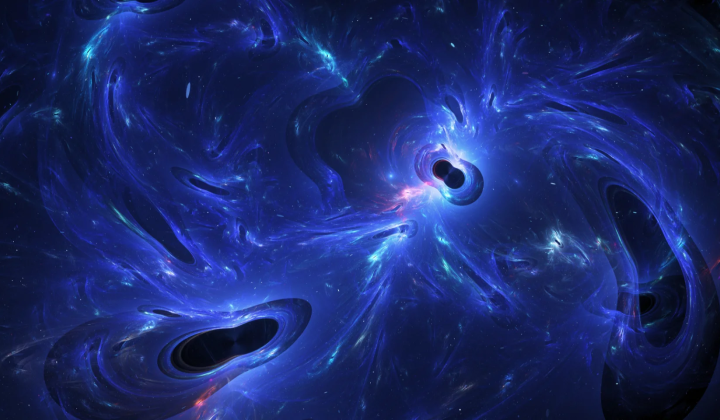
According to НВ — Техно: A team of physicists from the United States and Canada has introduced a groundbreaking dark matter framework modeled after the periodic table. Their theory suggests the presence of a mirror universe comprised of its own atoms, cosmic dust, and stars. Led by Pouya Asadi from the University of California, Santa Cruz, the study was published on the preprint repository arXiv. This model builds upon the Mirror Twin Higgs theory and seeks to explain why dark matter outweighs ordinary matter by roughly a factor of five in our universe.
Characteristics of the Mirror Universe
The research proposes that the early universe produced nearly equal amounts of ordinary protons and dark neutrons, with dark neutrons being about five times heavier than regular protons. In this mirror universe, dark neutrons are predicted to be lighter and more stable than their proton counterparts. Notably, dark protons can capture dark electrons and transform into dark neutrons, which eliminates the possibility of ordinary hydrogen existing within this hidden realm.
Scientists also hypothesize that dark analogs of several elements may exist in the mirror world, including:
- Deuterium
- Helium
- Lithium
- Beryllium
- Boron
- Carbon
Of particular interest is dark carbon, which could form solid crystals and clouds of dark cosmic dust. This dust would interact exclusively with dark photons, rendering it invisible to conventional telescopes. The model also envisions the formation of compact, highly dense mirror stars.
Although still theoretical, the researchers have outlined experimental strategies to validate their model. These include detecting two-stage wave signatures in the dark matter distribution and employing ultra-sensitive particle detectors. Such approaches could ultimately confirm or challenge the viability of this mirror matter hypothesis.
This research marks a significant advance in dark matter studies, a field that continues to puzzle scientists worldwide. Uncovering new theoretical frameworks and models not only deepens our understanding of cosmic phenomena but also inspires innovative experiments in astrophysics. With modern technology, testing these ideas could revolutionize our comprehension of the universe’s structure and the nature of its unseen components.
As researchers delve deeper into the mysteries of dark matter, understanding its implications for the universe's structure becomes increasingly vital. A recent study by mathematicians from California offers an intriguing alternative perspective on cosmic phenomena, challenging the conventional notion of dark energy. Explore how this new hypothesis could reshape our understanding of the universe's accelerated expansion.

Read also