IPC Responds to German Athletes' Protest Against Russian Anthem at Paralympics

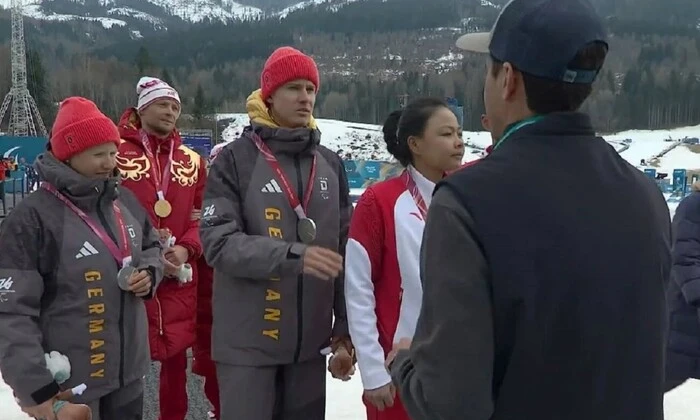
German Athletes Spark Controversy at Paralympic Games
According to Главком: The International Paralympic Committee (IPC) has provided an update on its investigation into German athletes Linn Kazmaier and Florian Baumann. During the medal ceremony at the Paralympics, the two competitors demonstratively turned away from the Russian flag and refused to remove their headgear while the Russian national anthem played. The incident stirred significant backlash, prompting the IPC to launch a formal review.
Craig Spence, the IPC's Director of Communications, confirmed to Glavkom that the committee had sent a letter to the German National Paralympic Committee requesting clarification on the matter. Spence stated:
'The case is ongoing.'
Additionally, Kazmaier and her guide Baumann declined to take a group selfie with Russian athlete Anastasia Bagiyan, who had won the sprint event at the Paralympic Games in Milan and Cortina d'Ampezzo. In the official photo, the German pair deliberately kept their distance from Bagiyan and her guide, Sergey Sinyakin.
Baumann also voiced his frustration with the IPC's decision to allow Russian athletes to compete under their own flag and anthem. He remarked:
'Four years ago in Beijing, we had great contact with the Ukrainians. We wanted to show them solidarity. This isn't about the Russian athletes-many of them are in a difficult position too. But I find it simply wrong that the IPC lets Russia compete here with its own flag and anthem while Ukrainians are also present.'
Kazmaier shared her personal feelings on the situation, saying: 'On a human level, I'm genuinely happy for these people. They might be very kind individuals we could even befriend. But it's politically unacceptable. It feels strange and wrong.'
Navigating Political and Ethical Tensions
As the case remains under scrutiny, the IPC intends to thoroughly examine the incident.
This event highlights the complex political and social challenges that arise in international sports, especially when nations in conflict are involved. The actions of Kazmaier and Baumann reflect their stance on current geopolitical tensions, sparking debate about the ethics of allowing athletes from countries with disputed international standing to compete. In handling this case, the IPC must balance its own regulations with public sentiment, which could impact the organization's reputation and the spirit of the games.
As the IPC continues to assess the implications of the protest by German athletes, it is essential to consider the broader context of athlete expressions at international events. This incident not only highlights the tensions surrounding national symbols but also raises questions about the committee's policies. For a deeper understanding of the ongoing review and its potential outcomes, you can read more about the current developments regarding the German athletes' protest.

Read also