Unexpected Slowing of Winds Detected on Hot Jupiters

Windspeed Discovery on Hot Jupiters Challenges Expectations
According to НВ — Техно: Led by Julia Seidel of the Côte d'Azur Observatory in France, a research team has found that wind speeds on hot Jupiters actually decrease as temperatures rise-a finding that may point to the presence of magnetic fields on these extreme worlds. The measurements were taken using the MAROON-X instrument on the Gemini North telescope and the ESPRESSO spectrograph on the European Southern Observatory's Very Large Telescope.
Key Traits of Hot Jupiters
Hot Jupiters are exoplanets that orbit extremely close to their parent stars, with some completing a full orbit in less than a day. One side of these planets is permanently locked facing the star, while the other remains in perpetual darkness. Scientists recorded wind speeds on these planets ranging from 2 to 7 kilometers per second-far faster than the most powerful winds in our Solar System, which top out at about 0.4 kilometers per second on Jupiter itself.
According to astronomer Vivien Parmentier, 'the hotter the exoplanet, the slower its atmosphere moves.' Vivien Parmentier
This observation contradicts conventional thinking, since hotter planets should have more energy to accelerate winds. Parmentier also noted that 'there must be a mechanism slowing down the atmospheric flows on the hottest objects.'
The magnetic fields of hot Jupiters appear to be modest-just a few Gauss, similar in strength to Jupiter's own magnetic field. If these findings hold up, they could become one of the strongest pieces of evidence yet for magnetic activity beyond our Solar System. However, directly measuring exoplanet magnetic fields remains impossible. Because the conclusions rely on indirect measurements, additional observations will be needed to confirm them.
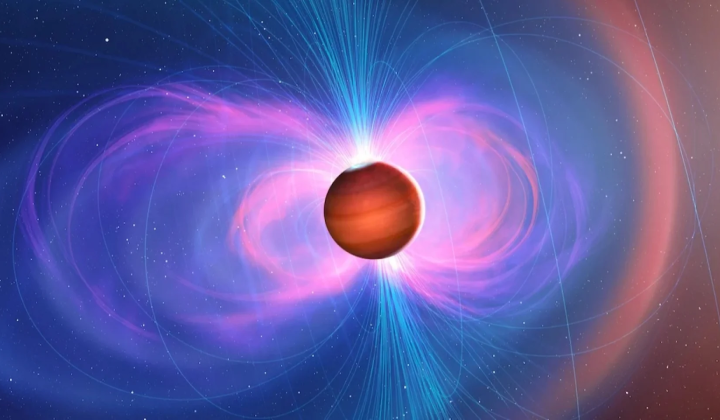
This research opens new avenues for studying exoplanets and, for the first time, allows scientists to compare the magnetic environments of other worlds. An artistic rendering of a hot Jupiter's magnetic field illustrates these scientific achievements. Science Alert highlights the significance of this work in advancing the field.
The discovery carries major implications for astronomy, deepening our grasp of atmospheric processes on exoplanets-especially hot Jupiters, which are fascinating due to their wide diversity. It also underscores the need for further observations to validate the results and build a clearer picture of magnetic fields outside our Solar System.
This intriguing discovery about wind speeds on hot Jupiters raises questions about atmospheric dynamics in extreme environments. For a deeper understanding of how these celestial bodies interact with their surroundings, explore the striking contrasts between day and night on a distant exoplanet, revealed by the James Webb Telescope.

Read also