Mars Helicopter Blades Reach Supersonic Speeds as NASA Prepares Next-Gen SkyFall Fleet for 2028

Breaking the Sound Barrier with Martian Rotor Blades
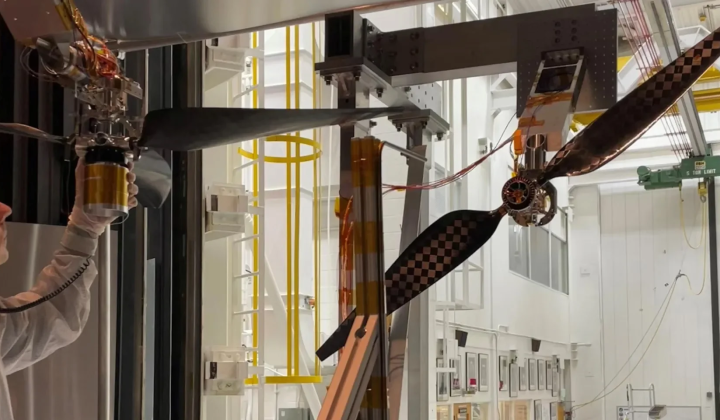
According to НВ — Техно: On November 18, 2023, NASA announced a breakthrough achievement: the rotor blades of a Mars helicopter successfully surpassed the speed of sound during tests conducted at the Jet Propulsion Laboratory in California. This milestone paves the way for the next generation of aerial explorers designed to carry scientific instruments across the Red Planet. As part of the SkyFall mission scheduled for December 2028, NASA plans to deploy three cutting-edge helicopters to investigate areas unreachable by rovers.
Rigorous Testing Under Martian Conditions
During a series of 137 test runs in March, the team simulated the thin Martian atmosphere-only about 1% the density of Earth's-using a low-pressure carbon dioxide chamber. To protect the chamber walls from potential damage caused by high-speed blades, metal reinforcements were installed. The three-bladed rotor spun at an impressive 3,750 revolutions per minute, pushing the blade tips to Mach 1.08, breaking the sound barrier. On Mars, where sound travels roughly 869 km/h due to the cold and CO2-rich environment, this represents a significant engineering feat.
Achieving these speeds boosted lift by 30% compared to previous models. NASA’s earlier Mars helicopter, Ingenuity, which completed 72 flights, had a rotational limit of 2,700 rpm with blade tips reaching Mach 0.7. For SkyFall's new two-blade rotor design, tests showed near-supersonic speeds at 3,570 rpm, indicating substantial improvements in performance.
“We expected to reach Mach 1.05, but the latest tests pushed us to Mach 1.08,” said NASA representative Shanna Vitro-Meyser.
NASA’s success in accelerating helicopter blades beyond supersonic speeds marks a major technological leap that could dramatically enhance how Mars is explored. The SkyFall project emphasizes the role of innovation in space missions, enabling the helicopters to access terrain off-limits to previous rovers and aerial vehicles. These advancements promise to deepen our understanding of Martian environments, an essential step toward human exploration of the planet.
As NASA continues to push the boundaries of aerial exploration on Mars, the recent advancements in helicopter technology are not the only exciting developments. The agency's ESCAPADE mission is also making headlines with its innovative flyby maneuvers near Earth, showcasing the agency's commitment to advancing space exploration ahead of the upcoming SkyFall mission.

Read also