NVIDIA Unveils GR00T 2 Model to Transfer Human Skills Directly to Robots

Introducing NVIDIA's GR00T 2 Robot Training Model
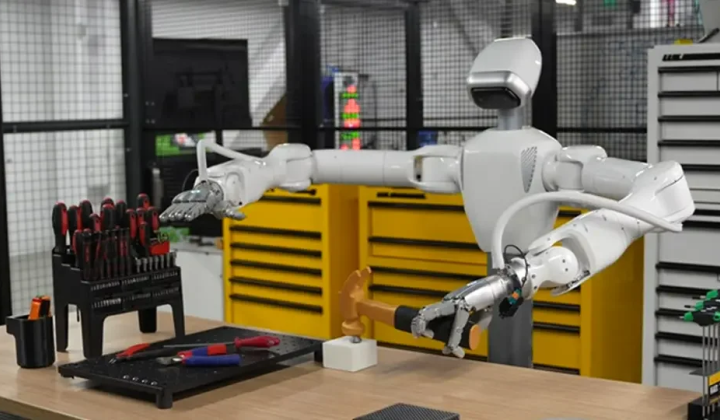
According to НВ — Техно: NVIDIA has launched GR00T 2, an innovative model designed to teach robots new skills by transferring knowledge from humans to machines that previously lacked those capabilities. Compatible with a variety of robotic platforms-including parallel grippers, five-fingered robotic hands, and humanoid robots-this model was revealed at the Robotics Learning Conference held in Austin, Texas, on November 9.
During testing across 50 different tasks, GR00T 2 achieved a 40% success rate without any task-specific training. After only five demonstration sessions, the model's performance surged to 95% success within just 30 minutes of fine-tuning on an NVIDIA RTX 5090 GPU. Processing each demonstration required under three minutes per task. This rapid learning was enabled by a method called cross-adaptation (X-Adapt), which proved highly effective in teaching robots new abilities. For example, a five-fingered robot successfully poured liquid into a laboratory funnel 65% of the time following a human demonstration, while the YAM robot assembled a toy dump truck correctly in 60% of trials after watching another manipulator robot perform the task.
Training Data Volume and the UQ-DAAAM AI System
The development of GR00T 2 leveraged an extensive dataset, including:
- 402,730 hours of first-person video footage
- 10,184 hours of hand grasp demonstrations
- 23,500 hours of robot teleoperation data
- 100,000 hours from the publicly available Human-1M dataset
The model employs reasoning modules to break down complex tasks into manageable steps. Additionally, its visual control mechanism boosts success rates for short tasks from 40% to 92%.
At the same conference, researchers from MIT introduced the UQ-DAAAM AI system, which enhances robots' ability to update object descriptions in memory. By analyzing images of items from multiple angles, UQ-DAAAM builds upon the earlier DAAAM framework that integrates computer vision with natural language processing. Objects are stored as part of a 3D environmental map, improving the robot's spatial understanding.
These breakthroughs from NVIDIA and MIT represent significant advancements in robotics, paving the way for machines that can learn and adapt to complex tasks more efficiently. Models like GR00T 2 have the potential to dramatically improve robot performance across industries ranging from manufacturing to healthcare, accelerating robotics integration into everyday life.
As the field of robotics continues to evolve, advancements in data processing are crucial for enhancing robotic capabilities. For instance, Bear Robotics has significantly reduced the data processing time for its KR1 humanoid robot to just 60 milliseconds using NVIDIA technology. This improvement exemplifies the ongoing efforts to optimize robot performance, making the integration of human-like skills even more efficient.

Read also