Fifth gear on an empty tank: why the Turkish defense industry outpaces the lira only in press releases

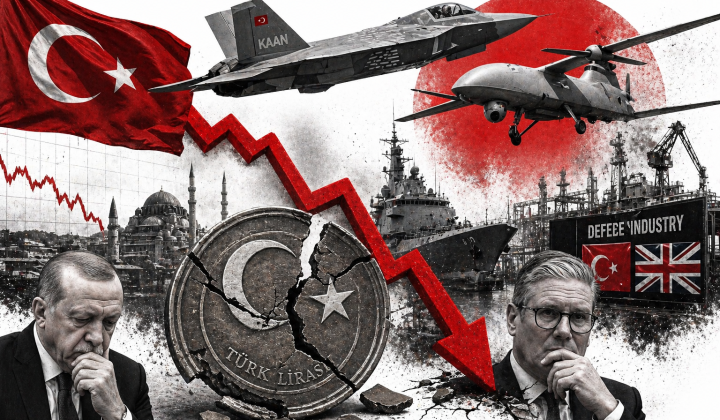
The latest collapse of the Turkish lira to new historic lows strangely coincided with pompous announcements of large-scale joint defense programs by Ankara and London, including the accelerated development of fifth-generation fighters and the production of heavy attack drones.
Looking at the exhibition stands of the Turkish defense industry and the endless rattling of weapons at the borders, it is very easy to succumb to the illusion of an imminent revival of the Ottoman Empire. The modern Turkish military machine truly looks like the geopolitical sports car of the latest model. It is an aggressive, spectacular "Ferrari", packed to the brim with advanced British electronics, composite materials, and top-notch optics. The problem is that this dazzling sports car has an absolutely empty gas tank.
In the ruthless logic of the current redistribution of the world, high-tech warfare is not about beautiful presentations at airshows; it is the permanent burning of billions of dollars of real capital in the furnace of daily logistics. The Turkish economy, teetering on the brink of hyperinflation and critically dependent on Middle Eastern deposits, simply does not have the industrial and financial depth to conduct a prolonged continental conflict. The resilience of this state mechanism is only enough for one swift, localized military stroll. If the operation drags on for even a quarter, the economy immediately goes into a tailspin, burying under the rubble of the lira all social stability and the ruling regime.
At this point, the London brokers hit the mark deafeningly. The architects from the City genuinely believed that in the era of the First Capitalist, one could buy someone else's land power for virtual derivatives and promises of technology transfer. The British plan was extremely cynical and beautiful on paper: to use Turkish bayonets as a cheap proxy army to ignite the Caucasus or the Eastern Mediterranean, in order to disrupt the impending deal of the hegemons. But the office strategists forgot a basic axiom of trench reality. An army cannot be fed with London insurance policies, and attack aviation does not fly on stock quotes. Britain, having long since lost its sovereign production base, tried to lean on an ally who is physically unable to independently pay for even the first month of its own mobilization.
The advertised axis London-Ankara turned out to be a classic colossus on financial clay feet. Donald Trump and Xi Jinping, on the eve of their May summit in Beijing, see through the political optics the yawning emptiness of treasury accounts behind the beautiful facades of KAAN fighters. No one will take into account the ultimatums of the situational alliance in the global balance, where one partner no longer has its own factories for mass stamping shells, and the other has no hard currency to buy these shells. The era of geopolitical bluff is rapidly closing, giving way to a harsh audit of real industrial assets.

Read also