How Professional Development Plans Align Employee Goals with Career Growth and Performance Tracking

Understanding Professional Development Plans (PDP)
According to AIHR: A Professional Development Plan (PDP) serves as a strategic framework that connects individual career ambitions with broader organizational objectives. It fosters consistency and fairness in employee growth, enabling managers and team members to collaborate on development discussions, set aligned goals, and monitor progress effectively. Human Resources plays a crucial role in supporting managers throughout this process by helping define objectives, outline actionable steps, and track advancements.
Key Elements of a Professional Development Plan
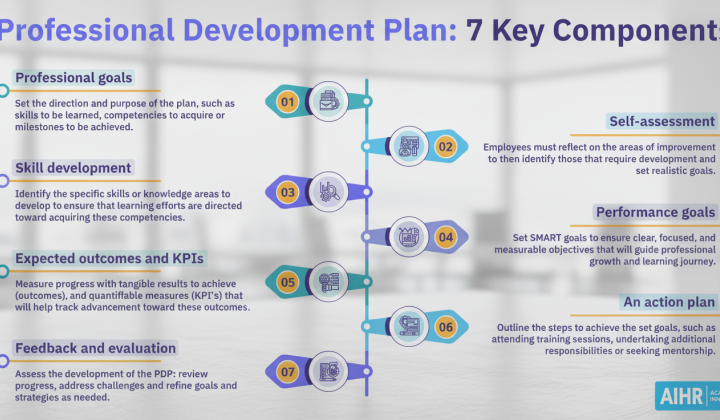
The core components of a PDP include setting clear professional goals, conducting self-assessments, skill enhancement, defining SMART performance targets, outlining expected outcomes and key performance indicators (KPIs), creating an action plan, and incorporating feedback and evaluations. For instance, a business development manager’s PDP might focus on improving negotiation, networking, sales, and presentation skills over a 6 to 12-month period. Meanwhile, a marketing coordinator’s plan could target campaign analytics and presentation abilities with an 18-month timeline.
There are several varieties of development plans, such as:
- Professional Development Plan
- Employee Development Plan
- Individual Development Plan (IDP)
- 30-60-90 Day Plan
- Performance Improvement Plan (PIP)
- Leadership Development Plan
The 30-60-90 Day Plan is designed to help new hires adjust by breaking down their first three months into distinct phases with specific objectives. In contrast, a PIP targets particular performance issues by setting clear expectations, goals, and deadlines, such as achieving target metrics within 60 days.
Leadership Development Plans emphasize cultivating strategic thinking, people management, and decision-making skills. Crafting a PDP involves several critical steps: an initial career goals discussion, self-assessment, identifying development needs, establishing SMART goals, formulating an action plan, conducting regular progress reviews, and updating the plan accordingly. Successful implementation within an organization requires leadership endorsement, structured plan design, manager training, open communication with employees, resource support, and ongoing process evaluation and refinement.
HR professionals are encouraged to maintain flexibility in development plans, fostering an environment where employees feel comfortable discussing their growth needs, while ensuring individual plans align with the company’s strategic goals. The benefits of adopting PDPs include accelerated career advancement, enhanced employee performance, higher engagement, improved retention rates, and stronger alignment with organizational values. Additionally, the AIHR offers a Learning & Development certification program that trains professionals in skills gap analysis, instructional design, L&D strategy, and learning analytics.
Implementing well-structured Professional Development Plans is a vital strategy for organizations aiming to boost employee effectiveness and support long-term career growth. In today’s rapidly evolving job market, flexible and adaptive PDPs can give companies a competitive edge by promoting talent development and aligning workforce capabilities with business priorities.
In light of the growing demand for professional growth, it's important to recognize that many employees feel their organizations are falling short in providing adequate advancement opportunities. This disconnect can impact overall performance and job satisfaction. To explore how companies can better support their workforce in achieving career aspirations, read more about the current challenges faced by employees regarding growth opportunities in this related article.

Read also