AI-Powered Drones Push Russian Forces to Adopt Dazzle Camouflage

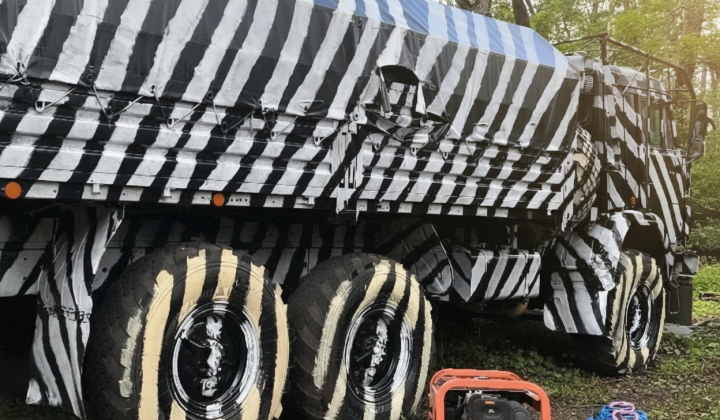
Dazzle Camouflage Used by Russian Occupiers
According to Главком: In response to the widespread deployment of Ukrainian drones equipped with artificial intelligence, Russian forces have begun applying dazzle camouflage to their military vehicles. Experts argue that this approach is futile, as modern machine vision systems and thermal imagers operate on entirely different principles.
Ukraine's systematic disruption of supply lines has forced Russian troops to seek new ways to evade machine vision. A recent photo of a Russian military Kamaz truck painted in an unusual pattern has sparked interest online. The dazzle camouflage pattern, originally developed during World War I to protect naval ships, was historically effective only on large vessels at great distances-raising serious doubts about its usefulness in today's battlefield conditions.
Modern Technology and Its Impact on Camouflage
Today's artificial intelligence analyzes geometric shapes, heat signatures, and object movement, rendering many traditional camouflage methods obsolete. A thermal imaging camera, for instance, can easily detect hot engines and wheels, making any paint job on the vehicle's body irrelevant. As a result, even with its new camouflage, the Kamaz's silhouette will remain visible due to its thermal footprint.
Russia's recent application of dark camouflage to the Black Sea Fleet frigate 'Admiral Grigorovich'-painting the bow and stern-further illustrates their attempt to adapt. However, experts stress that such changes cannot significantly improve concealment. Modern machine vision algorithms do not measure distance the way optical rangefinders did in the last century.
Experts believe that new technologies, such as thermal imagers, greatly complicate the ability to conceal military equipment.
This situation highlights how technological progress is reshaping warfare, with traditional camouflage losing its effectiveness against advanced surveillance tools. As drones and artificial intelligence play an increasingly central role, nations engaged in modern combat must rethink their concealment strategies and adapt to these emerging challenges.
As the conflict evolves, the integration of advanced technology is becoming increasingly crucial for both sides. For instance, the use of robotic combat missions by Ukraine has significantly influenced their strategic operations, showcasing how innovation can reshape military tactics in modern warfare.

Read also