Mars Dunes Shift by Several Meters Each Year Due to Seasonal Carbon Dioxide Cycles, Creating Tree-Like Optical Illusions

Seasonal Dynamics on Mars and Their Impact on Surface Features
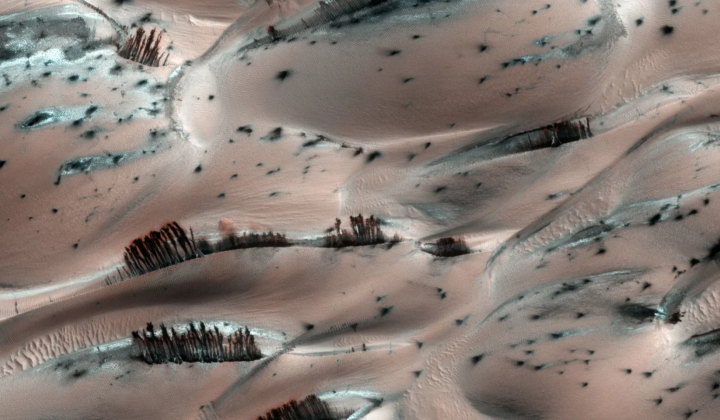
According to НВ — Техно: In 2008, the NASA Mars Reconnaissance Orbiter captured an image near Mars' north pole showing dark shapes that strikingly resemble trees. However, these are not actual trees but optical illusions generated by seasonal interactions involving frozen carbon dioxide on the dunes. A 2011 study revealed that these seasonal phenomena cause sand movement and alter the dune landscape by several meters throughout a single Martian year.
The image illustrates how winter on Mars causes atmospheric carbon dioxide to freeze, forming dry ice on the polar dunes. When spring arrives, this dry ice sublimates directly into gas rather than melting into liquid. This process triggers gas eruptions that lift dark sand onto the surface. As the sand cascades down dune slopes, it forms dark streaks resembling tree trunks and branches. The HiRISE camera also recorded a small dust cloud in the 2008 photo, indicating active sand displacement.
Understanding the Seasonal Cycle and Its Significance
Led by planetary scientist Candice Hansen-Koharcheck, research demonstrated that the lower edges of dune slopes move between 2.2 and 4.7 meters during one Martian year. With summer's arrival, the dry ice disappears, and winds smooth out the dunes, erasing sand displacement traces. The cycle repeats as winter returns and the dunes refreeze. These findings are crucial for comprehending Mars’ climate patterns and geological activity.
Studying these seasonal changes is vital for advancing knowledge of Martian geology and climate. Insights into the processes shaping Mars’ surface can inform the planning of future missions and enhance analysis of the planet's habitability potential. Additionally, comparing these dynamics with those of other planets aids scientists in better understanding the red planet's evolution within the Solar System.
Understanding the dynamics of Martian dunes not only sheds light on seasonal changes but also parallels research on how grain size influences wind speed on both Earth and Mars. This connection may enhance our comprehension of atmospheric conditions across different planetary environments.

Read also