Damascus Steel's Secret Revealed Two Centuries After Faraday's Experiments


The Legacy of Damascus Steel
According to НВ — Техно: Renowned for both its exceptional strength and striking appearance, Damascus steel boasts a deep historical legacy that stretches back to the 12th century, when Crusaders first encountered its remarkable qualities. The production of this steel became a focal point for many scientists, including Michael Faraday, who by 1820 was attempting to decode the chemical makeup of Damascus blades. Research continued into the 21st century: in 2006, a team from the Dresden University of Technology, led by Marianne Reibold and Peter Paufler, obtained a 17th-century Damascus saber sample linked to the master craftsman Assad Ullah.
To analyze the sample, the scientists dissolved a fragment of the blade in hydrochloric acid and examined the residue under an electron microscope. In a paper published in the journal Nature, they reported discovering carbon nanotubes within the steel's structure, with diameters slightly exceeding half a nanometer and carbon content reaching 1.5-2%. However, John Verhoeven of Iowa State University suggested that his colleagues might have mistaken cementite rods for nanotubes, pointing to potential gaps in the research-a possibility that Peter Paufler himself acknowledged.
Technological Breakthroughs and Ongoing Research
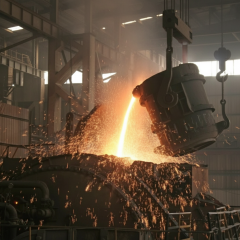
The foundation for Damascus blades was wootz, a high-carbon crucible steel originating from South India and Sri Lanka. The crucible was heated to temperatures exceeding 1400°C, with forging carried out within a temperature range of 850 to 650°C. Yet, the production of Damascus steel began to decline in the 18th century as South India's iron ore reserves, rich in vanadium, became depleted.
In the 1990s, John Verhoeven and blacksmith Alfred Pendray uncovered the role of vanadium in Damascus steel, detecting it in museum artifacts at levels around 0.004% (40 parts per million). In 1998, Pendray and Verhoeven published an explanation of the underlying mechanism in the journal JOM.
Thus, the story of Damascus steel weaves together legend, scientific inquiry, and technological achievement, underscoring its significance in the history of metalworking.
Research into Damascus steel continues to captivate the scientific community, as it opens new avenues for understanding ancient technologies and their influence on modern materials science. Studying the composition and properties of Damascus steel not only deepens our knowledge of metallurgical history but also offers critical insights for developing new materials that combine strength with aesthetic appeal.

Read also