A 150-Million-Year-Old Dinosaur's Uneven Footprints in Colorado Hint at a Limp

A Peculiar Walk: Was This Giant Colorado Dinosaur Lame?
According to НВ — Техно: Published on August 11 at 7:00 PM
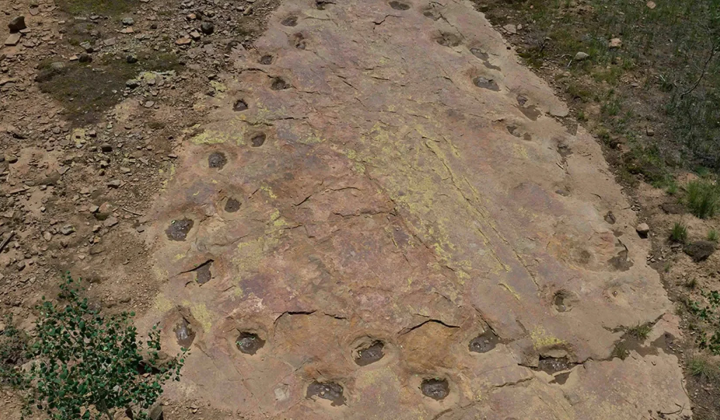
Scientists have analyzed a rare fossilized sauropod trackway about 150 million years old, discovered near Ouray in the U.S. state of Colorado. The trail is among the longest and most tightly curved ever documented, with footprints nearly completing a full circle. The study was led by Dr. Anthony Romilio of the University of Queensland, with Dr. Paul Murphy of the San Diego Natural History Museum as a co-researcher.
The team examined more than 130 individual footprints arranged along a continuous path stretching 95.5 meters. The trackmaker was likely a diplodocus or camarasaurus living near the end of the Jurassic period. To build a precise 3D model of the route, researchers used drones. The animal first headed northeast, then circled back around and resumed its original direction.
Reading the Tracks: What the Evidence Means
An analysis of the prints showed that the stride length varied considerably. The difference in length between left and right impressions was roughly 0.1 meter, or 10 centimeters. Scientists think this discrepancy could point to a mild limp or a preference for favoring one side while walking. The spacing between left and right prints also changed, from narrow to markedly wider. The tracks were found in the West Gold Hill area of Colorado.
This Colorado discovery opens fresh avenues for studying the behavior of giant reptiles that inhabited Earth more than 150 million years ago. Fossil footprints like these are especially valuable because they capture an animal's movement rather than its skeleton. The findings can help researchers better understand how these creatures interacted with their environment and with each other. Evidence of possible lameness may reveal physiological challenges faced by dinosaurs, offering new directions for paleontological research and for reconstructing Jurassic ecosystems.
In addition to the intriguing findings from Colorado, the discovery of a newly identified genus of bird-like dinosaurs in New Mexico further enriches our understanding of these ancient creatures. This recent classification highlights the diverse evolutionary paths of dinosaurs in North America during the same period, offering a broader context for studying their behavior and adaptations.

Read also