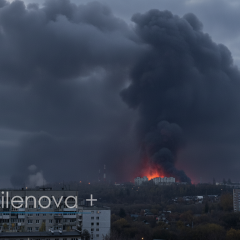
Five Strategic Sites in Russia Targeted by Ukrainian Drone Strikes Including Akhtubinsk Airfield and Nizhnekamskneftekhim Plant


Ukrainian Drones Strike Multiple Key Locations Inside Russia
According to ХВИЛЯ: In the early hours of November 15, Ukrainian drones launched coordinated attacks on five Russian targets, notably including the military airbase at Akhtubinsk, the petrochemical facility in Nizhnekamsk, and critical infrastructure in Taganrog. These operations are part of ongoing military efforts amid the prolonged conflict between Ukraine and Russia, reflecting a shift toward targeting strategic assets deep within Russian territory.
Details of the Attacked Sites
The strike on the Akhtubinsk airfield, situated about 620 kilometers from the frontline, was particularly impactful. According to Exilenova+, the base experienced at least 30 explosions that damaged key infrastructure, aircraft parking areas, ammunition storage, and other installations. This airfield houses the 929th State Flight Test Center of the Russian Ministry of Defense and is known for deploying Su-34 jets equipped with guided bombs against Ukraine. In August, the Ukrainian General Staff confirmed that a previous attack on Akhtubinsk had successfully damaged a Su-34 aircraft.
Another major target was the Nizhnekamskneftekhim plant, located 1,150 kilometers from the border. As one of the largest petrochemical complexes in Russia and Eastern Europe and part of the Sibur holding, this facility produces isoprene rubber, ethylene, propylene, and benzene. Initial assessments indicate the drones hit the ethylene production unit and other critical sections of the plant. The facility continued burning into the morning after the strike. It’s important to note that Sibur and Nizhnekamskneftekhim supply materials to Russian defense industries, including manufacturers of solid rocket fuel, engines, and warheads for cruise missiles.
The city of Taganrog, roughly 190 kilometers from the frontline, also suffered drone attacks targeting two electrical substations and a bridge. Rostov region Governor Yuri Slyusar reported that damage to one substation caused a power outage affecting the railway segment between Taganrog-Passazhirsky and Mikhailovka stations, resulting in suspended train operations. A fire broke out at the second substation, and the strike additionally damaged a road bridge, which was subsequently closed. This bridge serves as a detour route via Melentyevsky Bridge to the occupied city of Mariupol, used after the Natalievsky bridge over the Mius River was damaged.
"We expect to hear official updates on the damage assessment from the General Staff soon," Exilenova+ commented.
This series of strikes highlights the intensifying nature of the Ukraine-Russia conflict, with both sides striving to gain tactical advantages. Targeting strategic military bases and critical industrial plants could significantly impair Russia’s military capabilities and economic stability. Given the increased activity of Ukrainian drones, similar precision operations are likely to continue, potentially influencing the trajectory of the conflict in the months ahead.
As the conflict intensifies, the implications of these drone strikes extend beyond immediate military targets. For instance, a recent attack on a LUKOIL refinery in the Nizhny Novgorod region resulted in a significant fire, underscoring the escalating strategy of targeting critical energy infrastructure. This shift highlights the broader impact of Ukraine's military operations on Russian economic capabilities and warrants a closer look at how these developments unfold. For more details, read about the recent incident at the LUKOIL facility.

Read also