School of War Podcast Explores Napoleon, His Marshals, and France’s 2026 Unrest


Latest Episode of the School of War Podcast
According to ХВИЛЯ: On November 13, 2026, the School of War podcast released a new episode hosted by Aaron McLean, featuring historian Lord Andrew Roberts as the guest. This installment offers an in-depth exploration of Napoleon Bonaparte’s legacy, including his marshals, military innovations, and the political landscape across Europe and the United States. The discussion also addresses the ongoing riots in France during 2026 and the rise of extremism in Western countries.
Napoleon’s Military Campaigns and Reforms
Before Napoleon, the French army was dominated by aristocrats holding senior officer roles for centuries. The position of marshal existed in France since the 12th century, but during the French Revolution, the last marshals were executed. In May 1804, with no marshals left, Napoleon revived this institution, marking a new chapter. His era was defined by nearly 22 years of continuous warfare. The Revolution began in 1789 with the storming of the Bastille, and the Reign of Terror lasted until 1794. Napoleon’s coup on 18 Brumaire (November 1799) led to a five-year Consulate before he declared himself Emperor in 1804. The Napoleonic Empire endured for 11 years until his defeat at Waterloo in 1815.
Lord Roberts highlights that seven coalitions opposed Napoleon throughout his campaigns. Napoleon himself initiated two major conflicts: the Peninsular War and the 1812 invasion of Russia. The other five wars were launched by coalitions including Prussia, Austria, Russia, and Great Britain starting in 1792. Around 1803, Napoleon introduced the corps system-dividing his forces into units of 18,000 to 30,000 soldiers each, equipped with their own artillery, infantry, cavalry, staff officers, medics, and supply services.
Napoleon became a general at 24 and led the Army of Italy at 26, favoring rapid troop movements that outpaced his enemies by twice the speed. Before 1792, France did not practice mass conscription. Napoleon’s marshal institution began with 26 appointees selected based on merit rather than social class. Among these marshals:
- Five were aristocrats;
- Eleven rose from the ranks;
- Six became princes;
- Six were made dukes;
- Two were crowned kings.
Roberts also shared statistics on marshal injuries: six were wounded once, eight twice, while General Oudinot suffered at least 32 wounds. On average, each marshal sustained about 3.6 injuries, with only four escaping unscathed. Berthier, Napoleon’s chief of staff, developed an effective system for managing communications and orders, despite some personal conflicts within the leadership.
Contemporary Unrest and Rising Extremism
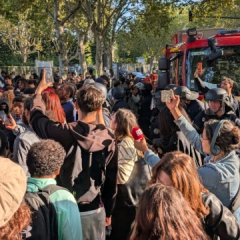
Turning to current events, France has experienced riots throughout 2026 amidst curfews. Similar disturbances erupted in Milan and Lisbon, where far-left groups, supporters of Jean-Luc Mélenchon, Islamist factions, and professional looters exploited the chaos for vandalism. Lord Roberts pointed out that street unrest has been a feature of French society since the Revolution of 1789. He expressed concern over the growing influence of extremist groups in Europe, especially in France, where upcoming elections are expected to be fiercely contested between Marine Le Pen and center-right candidates like Édouard Philippe.
In the UK, antisemitism has been on the rise during demonstrations, with Islamist factions reportedly taking control of the Green Party and steering it in an openly antisemitic direction. Meanwhile, in the US, the Democratic candidate in Michigan faced scrutiny over alleged ties to the Muslim Brotherhood. Roberts warned that these developments raise alarm in both the US and UK, as Islamist groups frequently exploit public disorder to carry out attacks.
The School of War podcast delves into pivotal historical moments and their echoes in today’s world. By examining Napoleon’s strategies and legacy, listeners gain insight into how history informs current political and social challenges. The parallels drawn between past upheavals and modern-day conflicts emphasize the ongoing relevance of extremism and political strife. Rising tensions across Europe and the United States signal troubling trends that could impact regional stability and security.

Read also